Wednesday, June 12, 2013

TaxProf Blog: Anderson: The Problem Is Not Just IRS Lawyers; The Problem Is All Federal Government Lawyers

TaxProf Blog


« Occupy Wall Street Stylists Pursue U.K. Tax Dodgers | Main | Increasing Federal Income Taxes on Punitive Damages »

June 11, 2013

Anderson: The Problem Is Not Just IRS Lawyers; The Problem Is All Federal Government Lawyers

IRS Logo 2Robert Anderson (Pepperdine), The IRS as Microcosm:

I searched the Federal Election Commission database for contributors with the term "lawyer" or "attorney" in thee occupation field. I then sorted the results by government agency (including the many permutations of agency names in the database). This produced a list of 20 federal agencies with at least 20 employees contributing to either Barack Obama or Mitt Romney in the 2012 election.

The results for the IRS were striking. Of the IRS lawyers who made contributions in the 2012 election, 95% contributed to Obama rather than to Romney. So among IRS lawyers, the ratio of Obama contributors to Romney contributors was not merely 4-to-1 at previously reported, but more like 20-to-1. The ratio of funds to Obama was even more lopsided, with about 32 times as much money going to Obama as to Romney from IRS lawyers.

So has the IRS gone off the rails into hyper-partisanship, leaving behind other more balanced federal agencies? ... The data show, however, that the partisanship of the lawyers in the IRS is not unusual or even particularly extreme among federal agencies. In fact, the lawyers in every single federal government agency--from the Department of Education [100%] to the Department of Defense [68%] -- contributed overwhelmingly to Obama compared to Romney. The table below shows the results for all agencies with at least 20 employees who contributed to either Obama or Romney. ... 

AGENCY


NUMBER OF LAWYERS CONTRIBUTING TO

PERCENT OBAMA


OBAMA

ROMNEY

NLRB

44

0

100.00%

UNITED NATIONS

23

0

100.00%

DEPT. OF EDUCATION

47

0

100.00%

DEPT. OF LABOR

66

2

97.06%

FEDERAL PUBLIC DEFENDER

65

2

97.01%

FINRA

26

1

96.30%

FEDERAL ENERGY REGULATORY COMM.

23

1

95.83%

ENVIRONMENTAL PROTECTION AGENCY

86

4

95.56%

FEDERAL TRADE COMMISSION

80

4

95.24%

INTERNAL REVENUE SERVICE

38

2

95.00%

... The IRS is near the top in terms of partisanship, but does not stand out as being markedly different from the other agencies. Some agencies, such as the Department of Education and the NLRB, did not have a single lawyer who contributed to Mitt Romney, even though dozens contributed to Barack Obama. The Department of Justice had the largest number of lawyer contributors of any federal agency, and 84% of those employees contributed to Obama. ...

The political contribution numbers of government lawyers show that the IRS controversy is really a symptom of a larger disease -- the rule by career bureaucrat lawyers. Lawyers as a group are not politically representative of the country as a whole, and neither are government employees, so the combination of the two of them creates a dramatic mismatch with the bulk of America. The result of the mismatch is that government agencies lack the political diversity that is necessary to effectively represent the American people. The idea that the Department of Justice, on which we depend for fair and impartial enforcement of the law, is so overwhelmingly tilted to one side should make everyone uneasy regardless of political viewpoint. Whatever the reason for the disparity,the numbers reveal a severely dysfunctional culture in government agencies, one that does not serve the country well.

The media and Congress have understandably focused on the IRS specifically in sorting out the controversy. The numbers, however, suggest that the problem is not with the IRS in particular, but with the federal government as a whole (and indeed, with state governments as well). The root of the problem is the rule by a class of career government employee lawyers who lack the diversity of opinion that is found in the non-lawyer private sector. The IRS inquiry, rather than focusing narrowly on "who knew what" within the agency, should lead to a top-to-bottom rethinking of who's doing the administration in the modern bureaucratic administrative state.

June 11, 2013 in IRS News, Tax | Permalink

TrackBack

TrackBack URL for this entry:
http://www.typepad.com/services/trackback/6a00d8341c4eab53ef0191033bb44b970c

Listed below are links to weblogs that reference Anderson: The Problem Is Not Just IRS Lawyers; The Problem Is All Federal Government Lawyers :

Comments

Economically speaking, isn't there probably a pretty good argument that whether or not they actually believe in President Obama's policies, those lawyers were just protecting their own interests, since Romney made lots of noise about eliminating government jobs?

That cynical perspective aside, "government lawyers" as a group, and especially those working for the agencies listed here, are going to be inherently politically self-selecting. When one party's principles call for raising tax burdens and a personal responsibility to "pay one's fair share," and the other's call for minimizing tax burdens and applaud clever tax avoidance, the sort of people who actually want to work for the agency in charge of collecting taxes are probably going to fall primarily on one side of the aisle, no?

Anderson explicitly states that he's ignoring the reasons behind the disparity, but it's hard to do so when they preclude any effective solution to the problem. Where exactly is the IRS, or the Department of Labor, or the EPA going to find Republicans who even _want_ to work for them, much less have the requisite qualifications or necessarily low salary requirements?

Posted by: K1 | Jun 11, 2013 4:28:25 PM

What would be far more meaningful would be the addition of a third column that showed the number of lawyers in each agency that give to neither candidate. I wager that most agency attorneys abstain from making political gifts. The problem with reporting that data would be that the story may evaporate. Doing good empirical research is rough because it often produces a result that does not support the author's hypothesis.

Posted by: Bill Turnier | Jun 11, 2013 4:33:07 PM

Bill,

I starting shaking my head as soon as I saw that third column was missing. This study is woefully incomplete.

Posted by: HTA | Jun 11, 2013 5:10:09 PM

Alternative theory; the Obama administration sent out word that anyone NOT donating heavily to the Obama re-election campaign might find themselves "sequestered" out of a job!

Posted by: Michael Rivero | Jun 11, 2013 5:11:44 PM

It's the chicken or the egg theory. Are the lawyers liberals when they go into government work, or do they tend that way to support their own jobs.

My experience? They are liberals when they come in. Why? Because they are willing to take lower salaries than those offered by private practice. They want to save the world.

Posted by: of course | Jun 11, 2013 5:15:49 PM

Of course, maybe people who support the opposition will be more likely to contribute to a 501c4 instead of directly to the candidate...If that is true, this chart tells me that Obama was president in 2012, and the GOP candidate was the challenger.

Posted by: Anon | Jun 11, 2013 5:18:54 PM

these data would be more meaningful if romney were a credible candidate.

Posted by: r. willis | Jun 11, 2013 7:05:08 PM

Speaking from personal experience, the data above appears to reflect the truth. When I practiced law for a Federal agency, at least 9 of 10 attorney colleagues were committed and vocal supporters of the Democratic Party. Government attorneys of the Republican stripe were a very small minority, and often ridiculed by their peers.

It really does not require too many grey cells to understand the mutual attraction between the Federal civil service and attorneys who support a larger government. People who dispute this relationship have their head in the sand.

Posted by: Jake | Jun 11, 2013 8:49:31 PM

What a meaningful application of "science"!

Posted by: person | Jun 11, 2013 9:43:50 PM

Anyone reading this would automatically look for some data on the number of lawyers; Robert Anderson is expert enough that this cannot have been inadvertent, so by his kind of analysis it suggests a massive right-wing conspiracy.

I jest, of course. But: "The political contribution numbers of government lawyers show that the IRS controversy is really a symptom of a larger disease -- the rule by career bureaucrat lawyers . . . a dramatic mismatch with the bulk of America." I mean, really.

Posted by: Ed | Jun 11, 2013 9:45:00 PM

Conservatives at management levels in federal agencies are treated the same as conservative professors in most universities -- they better keep their opinions to themselves and not be politically active if they know what's good for their careers. The Obama Administration's Chicago-styled politics with a history of personal destruction doubles down on the threats. That emboldens liberals in agencies who can use their positions to attack conservative donors and organizations.

Posted by: Woody | Jun 11, 2013 10:25:15 PM

I worked as an attorney for the IRS Chief Counsel Office for a year. I was not aware of any other attorney's contributions or affiliations with any party. My take was that everyone there had a job to do, and they did it.

Posted by: Allen | Jun 12, 2013 12:59:51 AM

Those who hate government in general and the tax man in particular do not apply for government jobs or try to become the tax man. My bet is that this is a universal law which you could get confirmed in any country.

Posted by: GSo | Jun 12, 2013 6:32:38 AM

Post a comment


Sent from my iPhone

Tuesday, June 11, 2013

Sober Look: Misreading the tea leaves of the broad money supply

Misreading the tea leaves of the broad money supply

Some economists continue to misinterpret the recent movements in M2, one of the measures of the US broad money supply. People use this indicator to argue all sorts of things - from a slowdown in lending to the reason for low inflation and even as a harbinger of a major correction in equities. While such conclusions could certainly end up being correct, it is unlikely that the movements in M2 have anything to do with it.

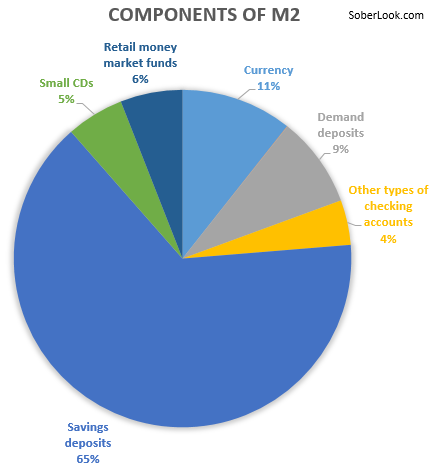
First of all, what exactly is M2? The chart below shows the components (one item not shown is the amount in travelers checks - too small to be displayed on this chart).

"Small CDs" = under $100K; "Currency" = physical bills

The money supply is one of those measures that is not supposed to be impacted by asset rotation. For example if you use your cash to buy a car or a stock, someone else will have your cash - so the overall amount of cash in the system has not changed. If people move money from savings to checking, the aggregate once again should stay the same.

In theory this factor would be impacted primarily by banks lending money. For example, Sarah deposits $100 at a bank. Frank borrows $90 from the same bank and deposits it there (maybe temporarily). Now deposits have increased from $100 to $190, which would show up in M2 (and the bank has increased its leverage ratio).

But there are two components of this measure that cloud this logic: Certificates of Deposit (CDs) and Money Market Funds. If funds come out of these two categories and get deployed in say a short-term bond fund or a stock fund for that matter, M2 would decline. That is if Sarah swaps her CD for a mutual fund, (unwinds the CD or lets it mature and uses the proceeds to buy the fund), the cash balance does not change but the CD amount in the system declines. That will result in lower M2.

We know that both money markets funds (see discussion) and CDs (see discussion) have seen material declines recently. People move funds from these two categories into high yielding savings accounts as well as to bond funds and recently stocks (rather than into another CD). The net effect is lower CD amount outstanding and slower than expected growth in M2 - which is unrelated to bank lending.

Looking at how the components of M2 changed over the past 3 months (chart below), we in fact see the declines in these two categories.


From this measure alone we can't tell how much of the declines in CDs and money market funds went into deposits and how much ended up in bond funds or stocks. We do know however that mutual fund inflows have been strong across the board recently.

Source: ICI

Whatever the case, lower CD and money market amounts outstanding result in a reduction to M2. Some economists prefer using MZM rather than M2, which excludes CDs but includes institutional money market funds instead. Institutional money funds however have also been declining (as the SEC pushes to implement regulatory changes that will result in these funds fluctuating in value.) Therefore MZM is impacted by this "asset rotation" as well, although potentially at a different rate. Therefore, before reading too much into the movements in broad money supply measures, one should consider the components of these indicators and what the changes in the components really tell us.


SoberLook.com
From our sponsor:
Why you should look at "Line Item 12" of Michelle Obama's tax returns. Look at the astonishing numbers Michelle is posting to her tax returns.


Sent from my iPhone

Friday, June 7, 2013

An IRS Political Timeline

An IRS Political Timeline

President Obama spent months in 2010 warning Americans about the 'threat' to democracy posed by conservative groups, right at the time the IRS began targeting these groups.

Barack Obama warns the country about conservative groups, Aug. 9, 2010 Photo: Agence France-Presse/Getty Images

By Kimberley A. Strassel

Perhaps the only useful part of the inspector general's audit of the IRS was its timeline. We know that it was August 2010 when the IRS issued its first "Be On the Lookout" list, flagging applications containing key conservative words and issues. The criteria would expand in the months to come.

What else was happening in the summer and fall of 2010? The Obama administration and its allies continue to suggest the IRS was working in some political vacuum. What they'd rather everyone forget is that the IRS's first BOLO list coincided with their own attack against "shadowy" or "front" conservative groups that they claimed were rigging the electoral system.

Below is a more relevant timeline, a political one, which seeks to remind readers of the context in which the IRS targeting happened.

Aug. 9, 2010: In Texas, President Obama for the first time publicly names a group he is obsessed with—Americans for Prosperity (founded by the Koch Brothers)—and warns about conservative groups. Taking up a cry that had until then largely been confined to left-wing media and activists, he says: "Right now all around this country there are groups with harmless-sounding names like Americans for Prosperity, who are running millions of dollars of ads . . . And they don't have to say who exactly the Americans for Prosperity are. You don't know if it's a foreign-controlled corporation."

Aug. 11: The Democratic Congressional Campaign Committee sends out a fundraising email warning about "Karl Rove-inspired shadow groups."

Aug. 21: Mr. Obama devotes his weekly radio address to the threat of "attack ads run by shadowy groups with harmless-sounding names. We don't know who's behind these ads and we don't know who's paying for them. . . . You don't know if it's a foreign-controlled corporation. . . . The only people who don't want to disclose the truth are people with something to hide."

Week of Aug. 23: The New Yorker's Jane Mayer authors a hit piece on the Koch brothers, entitled "Covert Operations," in which she accuses them of funding "political front groups." The piece repeats the White House theme, with Ms. Mayer claiming the Kochs have created "slippery organizations with generic-sounding names" that have "made it difficult to ascertain the extent of their influence in Washington."

Aug. 27: White House economist Austan Goolsbee, in a background briefing with reporters, accuses Koch industries of being a pass-through entity that does "not pay corporate income tax." The Treasury inspector general investigates how it is that Mr. Goolsbee might have confidential tax information. The report has never been released.

This same week, the Democratic Party files a complaint with the IRS claiming the Americans for Prosperity Foundation is violating its tax-exempt status.

Sept. 2: The Democratic Congressional Campaign Committee warns on its website that the Kochs have "funneled their money into right-wing shadow groups."

Sept. 16: Mr. Obama, in Connecticut, repeats that a "foreign-controlled entity" might be funding "millions of dollars of attack ads." Four days later, in Philadelphia, he again says the problem is that "nobody knows" who is behind conservative groups.

Sept. 21: Sam Stein, in his Huffington Post article "Obama, Dems Try to Make Shadowy Conservative Groups a Problem for Conservatives," writes that a "senior administration official" had "urged a small gathering of reporters to start writing on what he deemed 'the most insidious power grab that we have seen in a very long time.' "

Sept. 22: In New York City, Mr. Obama warns that conservative groups "pose as non-for-profit, social welfare and trade groups," even though they are "guided by seasoned Republican political operatives" who might be funded by a "foreign-controlled corporation."

Sept. 26: On ABC's "This Week," Obama senior adviser David Axelrod declares outright that the "benign-sounding Americans for Prosperity, the American Crossroads Fund" are "front groups for foreign-controlled companies."

Sept. 28: The president, in Wisconsin, again warns about conservative organizations "posing as nonprofit groups." Sen. Max Baucus, chairman of the Senate Finance Committee, writes to the IRS demanding it investigate nonprofits. The letter names conservative organizations.

On Oct. 14, Mr. Obama calls these groups "a problem for democracy." On Oct. 22, he slams those who "hide behind these front groups." On Oct. 25, he upgrades them to a "threat to our democracy." On Oct. 26, he decries groups engaged in "unsupervised spending."

These were not off-the-cuff remarks. They were repeated by the White House and echoed by its allies in campaign events, emails, social media and TV ads. The president of the United States spent months warning the country that "shadowy," conservative "front" groups—"posing" as tax-exempt entities and illegally controlled by "foreign" players—were engaged in "unsupervised" spending that posed a "threat" to democracy. Yet we are to believe that a few rogue IRS employees just happened during that time to begin systematically targeting conservative groups? A mere coincidence that among the things the IRS demanded of these groups were "copies of any contracts with and training materials provided by Americans for Prosperity"?

This newspaper reported Thursday that Cincinnati IRS employees are now telling investigators that they took their orders from Washington. For anyone with a memory of 2010 politics, that was obvious from the start.

Write to kim@wsj.com.


Sent from my iPhone

Sunday, June 2, 2013

The Grounding of Big Government

THE GROUNDING OF BIG GOVERNMENT

You remember near the end of the Monty Python flick, The Meaning of Life-- that scene featuring Mr. Creasote? He's the morbidly obese freak who gorges on food, until finally, after eating a mint offered by the waiter, completely explodes, sending his guts in all directions.

I was a senior in high school when I saw it, and I remember it clearly. I skipped dinner that night.

And I remember the scene now, as I've watched this IRS scandal unfold. I keep thinking about that mint, and that this scandal is that mint.

With this exposed plan of intimidation, big government has finally, irrevocably exploded all over us--drenching us in its own corrupt excesses. It's gotten so fat, so immensely greedy, so impossibly grotesque, that the only thing that can end it is itself.  Big government exists only through expansion. The bigger it gets, the harder it is to kill. But it got too cocky; it grew too fast, and now all of its insides, are outside--for all of us to see.

Which is why this is no time to lend it a helping hand. Let big government die from its own desires. The IRS, to its own horror, has just helped create a new movement. Think about it: If you were to go to a hardware store right now, buy a sign and paint "audit this," and place it on your lawn, what could they do? Nothing. Once you've got a thug's number, the thug knows better than to target you.
 
Nevermind the appeasers--the IRS scandal IS a big deal. It's such a big deal, it could ruin the agency forever, and take a few others down with it. And sure, it's a lot of fun on the right to be clamoring for scalps--like, who should be fired and how many. But pink slips are small potatoes.

The end game is way, way bigger than that stuff. What we are witnessing is a collapse of trust in big government, which ultimately--to our benefit as small-government types--leads to a permanent undermining of the whole system. 

Until now, this administration produced loads of soaring rhetoric that made many forgive its lack of substance. But now, to everyone who pays taxes, the wolf is suddenly at the doorstep, and it's looking for food. This new era, for some, sounded great in the abstract--but with the IRS scandal, we're starting to see our first home front casualties. The IRS just gave small-government America--which is most of America--a wake-up call like no other. 

The IRS scandal, if perceived correctly, spells the end of big government.

Because a group of average Americans mobilized as something delightfully known as the Tea Party, and made their voices heard for the first time, they were targeted. It's not about the IRS solely, but an administration that used the IRS as its enforcement arm against speech it found disagreeable. 

They used the government to silence opposition. The IRS was their national muscle, used locally, to scare the crap out of you. They're so powerful, they don't even need to break your kneecaps. They just break your soul.

And it used to work--but not so much anymore.  I'm thinking (which I do now and again) that if everyone now does what those brave folks did when Obamacare first reared its ugly head, what exactly can the government do now?

If the IRS is forever tainted as an agenda-driven, ideologically poisoned outfit, then it's powerless to continue its normal routines. It's like a shoplifter in the neighborhood. With his photo now plastered in every shop window, everyone knows his game, so he's gotta go somewhere else. 

The only recourse: going after the left. Or, just going away.

When I talked about grounding government, this is how it's done. The IRS, through its actions, has grounded itself--disqualifying the joint from effectively coercing you to do anything without that being perceived as targeting. When President Obama said cynicism is a threat to democracy, he was looking through the kaleidoscope from the wrong end. It's corruption that threatens big government. When, during that speech on drones, he defended his use of targeted lethal attacks on enemies, he could have just as easily been describing the IRS attacks on the right. This strategy is part of who they are. If you're a big government lover, you are programmed to hate us and any person who threatens that cushy livelihood. 

Which is why you should become that person. Doing so creates a force field against attack. When Elijah Cummings fretted that the IRS scandal could endanger future audits against citizens, it was a selfish, bizarre reaction to government overreach (siding with the attacker, not the victim)--but he was also right. 

The IRS just dug big government's grave. America now has the opportunity to look at the greedy monster that is expansive, progressive government and say, "We are done with you. Go away."


Sent from my iPhone

Link from Twitter


Sent from my iPhone

Tuesday, May 28, 2013

Labor big a real heavy sleeper - m.NYPOST.com

Labor big a real heavy sleeper

Union fat cat Mark Rosenthal spends more time sleeping at his desk than organizing labor, a series of damning photos reveals.

The 400-pound president of Local 983 of District Council 37 — the city's largest blue-collar municipal-workers union — often downs a huge meal, then drops into dreamland in the early afternoon, members of the union's executive board told The Post.

IT'S A DREAM JOB: Mark Rosenthal, who pulls in $156,000 a year as head of Local 983 of District Council 37, nods off at his desk during one of a series of postlunch naps that have outraged members of the union's executive board.

"He eats lunch when he arrives at work at 2 p.m. Then, like clockwork, he goes to sleep with a cup of soda on the table and the straw in it," said Marvin Robbins, a union vice president.

"Then he wakes up, looks at his watch and says, 'I have to get out before the traffic gets bad.' He's usually out by 4 p.m. after being at the office two hours."

Rosenthal is a former Parks Department employee who rose to power campaigning to rid the union of corruption in the late 1990s.

He last made embarrassing headlines in 2009, when he inspired a City Council bill requiring jumbo-size ambulances for morbidly obese patients after he had a stroke at City Hall.

Since then, he hasn't been making much of an effort to give the city's ambulances a break and slim down. Union officials say he racks up $1,400 in monthly food bills on the union dime.

Much of the 5-foot-7, 400-plus-pound Rosenthal's food tabs are for catered union events and meals he writes off as "union business," board members claim.

They say he significantly overorders at eateries like Dallas BBQ, the Stage Door Deli and Pine Restaurant in The Bronx, a hangout for local politicians, and takes the extra food back to his Bronxdale apartment.

"He's always walking off with a doggie bag or extra boxes of food," said another executive board member.

Rosenthal, who earns $156,000 annually, yesterday denied being a free spender— and insisted he works "12-to-14-hour days."

He says the allegations are "part of a smear campaign" by a faction trying to get another Local 983 vice president, Joseph Puleo, elected president in a June 5 showdown.

He said it's normal for executives to take "power naps."

He also blamed his meetings with the sandman on the effects of pain medication he takes for backaches he has suffered since he fell through a chair at a McDonald's last year.

"The chair broke because I'm big," Rosenthal said.

"I'm 60 years old, so if I eat during my lunch hour and take a little medication, can't I close my eyes?" he said outside his apartment complex. "Is it so outrageous?"

Rosenthal is also under fire from the union's executive board for allowing lawyer Arthur Schwartz to allegedly rack up an average of $12,000 a month in union legal fees for years despite being on a $5,500 monthly retainer, board members said.

But Schwartz claims he has submitted only one monthly bill over $10,000 in 15 years representing the union and averages about $7,000 per month in fees.

APRIL 2, 2013

The executive board on May 15 voted to fire Schwartz anyway — and also to pull Rosenthal's union car.

Board members said they were furious enough to fire Schwartz because he pursued a lawsuit on Rosenthal's behalf aimed at changing the makeup of the union's election committee after it nominated Puleo as a candidate for president on May 7.

Rosenthal responded to Schwartz's firing by filing another suit days later in Manhattan Supreme Court, claiming the May 15 meeting occurred without his approval.

The suit also accuses executive board members of using union resources to sway the election in Puleo's favor.

"Mr. Puleo and his cohorts have basically seized control without having won the election," the suit says.

"Not only that, [but] they have [also] assigned legal work to attorneys, including to Mr. Puleo's campaign lawyer."

MARCH 27, 2012

Puleo called Rosenthal's allegations "absurd," adding, "He's the one using the union's resources to sue members in good standing."

The case has since been moved to a federal court in Manhattan with a hearing set for today.

The union represents 3,000 workers — mostly Parks Department peace officers and maintenance workers and NYPD tow-truck operators and other traffic agents that are among the lowest-paid city workers.

But they still fork over $1,080 in annual union dues that help fund Rosenthal's salary and perks.

Rosenthal has headed the union since 1998, when he won an election under the platform of ridding the union of corruption and alleged mob ties. At the time, he called the union a "cesspool."

Some members say he was a strong labor advocate for the union in his early years, but his questionable spending and sleeping habits — and alleged lack of attention to union issues — in recent years led to Puleo's campaign.

He has also ruled the union with little opposition in part because he and Schwartz have strong political connections at City Hall, so members say they were afraid to go up against them until now.

"There was always the fear that he'd use his power to retaliate against anyone who spoke up," Puleo said.

"He always likes to say he's a big supporter of Mayor Bloomberg and the fact that the mayor called him to thank him for his support when he was elected.

"I would love to see the mayor's face if he saw the big sodas that he likes to drink. It's kind of ironic."

Additional reporting by Lorena Mongelli

rcalder@nypost.com

MAY 16. 2012


Sent from my iPhone
Sunday, May 26, 2013

Prepare to Start Making Things Again - By Charles R. Morris | Foreign Policy

Prepare to Start Making Things Again

China's march to global dominance in manufacturing is slowing down. By Chinese standards, its official claim of 14.7 percent year-to-year growth in exports for April is relatively lackluster -- and the physical trade flow data suggest that it may be overstated by as much as 60 percent. The image of the robotic "blue ant" Chinese worker-hordes is long out of date. The country's spectacular economic growth has vaulted large segments of its population into the middle class, and they want better pay and benefits, shorter work weeks, and other perquisites that their Western peers enjoy.

As China's momentum slips, U.S. manufacturing fortunes are on an upswing. U.S. corporations made unusually high profits in the wake of the Great Crash: During the weak recovery years of 2010-2012, after-tax corporate profits were 43 percent higher than during the stronger recovery of 2003-2005, according to my calculations. Workers took the brunt of the decline, while corporations invested their savings in a brutal restructuring of production operations. Cruel as that was, the United States has emerged from the crash as one of the world's most cost-competitive manufacturers.

According to the Boston Consulting Group (BCG), Chinese worker productivity is still growing at about 8 percent a year, an extraordinary rate -- but worker compensation is growing more than twice as fast. From 2000 to 2010, average wages in south China's Yangtze delta, a manufacturing hotbed, jumped from $0.72 an hour to $8.62. Factoring in worker output, land costs, and the rising costs of long-distance shipping (as well as the relative lack of corruption), U.S. manufacturing is approaching competitive parity with China. BCG also estimates that the United States can undersell firms in Japan and Europe by as much as 25 to 45 percent, and that it may also have the world's best trade logistics capabilities.

The hidden costs of outsourcing often loom the largest, but they don't show up on profit statements. For example, when General Electric, a pioneer of offshoring among U.S. flagship companies, began moving its multi-billion dollar appliance manufacturing back from China as costs converged, they discovered that the lack of contact between their design and production teams had caused their designs to stagnate. The company realized a 20 percent overall savings on their first "reshored" appliance, a water heater, just by re-engineering it to reduce material costs and labor inputs. Onshore production also makes it easier to keep up with today's just-in-time delivery mandates and ever-more-rapid product cycles. (And like all U.S. companies, GE has become very wary of the Chinese propensity to knock off market-leading product designs.)

The data supporting the manufacturing recovery story are still mostly anecdotal, but the anecdotes are coming in floods, not as straws in the wind. Recent surveys show that up to a fourth of U.S. companies offshoring in low-income countries have been moving some or all of their production back home, while a third are researching the question. Meanwhile, at home, factory automation keeps labor-force costs in check, and U.S. manufacturing unions are far less militant than they once were. Caterpillar, Ford, and Whirlpool have been reshoring major product lines as well, and other major manufacturers will likely follow.

Meanwhile, an impressive list of foreign companies is relocating factories to the United States: Samsung is building a semiconductor plant in Texas; Airbus will make planes in Alabama; Toyota is outsourcing production of minivans to Indiana for export to Asia. Rolls-Royce has been expanding its U.S. airplane engine parts production operations to service its global customers.


Sent from my iPhone
Thursday, May 23, 2013

Fwd: Benghazi: Demand the Truth


Sent from my iPhone

Begin forwarded message:

From: Jerry Villella <jerryvillella@yahoo.com>
Date: May 23, 2013, 4:54:25 AM CDT
To: Jerry Villella <jerryvillella@yahoo.com>
Subject: Benghazi: Demand the Truth

Check out this video on YouTube:

http://youtu.be/ENq_y6JVZj4


Sent from my iPhone

Thursday, May 16, 2013

Men who are physically strong are more likely to have right wing political views | Mail Online

Found this interesting link on the Drudge Report:

Men who are physically strong are more likely to have right wing political views | Mail Online

http://www.dailymail.co.uk/health/article-2325414/Men-physically-strong-likely-right-wing-political-views.html


The Official Drudge Report iPhone, iPad or iPod Touch app available in the iTunes App Store:
http://itunes.apple.com/us/app/official-drudge-report-free/id375614185?mt=8


Sent from my iPhone

Tuesday, May 7, 2013

Unemployment in the Age of Capital Abundance | Macrofugue Analytics

Unemployment in the Age of Capital Abundance

I – The Nominal and the Real

In economics, there are two kinds of problems:  real problems and nominal problems.

Moai_Rano_rarakuThe deforestation on Easter Island destroyed most of the Rapa Nui.  When it was necessary to leave the island and start new lives in a new land with an environment able to support their people, there were not enough large trees left to build ocean-worthy vessels.  Their population declined to 15-20% of their peak population within a century.

This is an example of a real problem. A real problem is a lack of natural resources, capital goods, land or labour, or when any combination of these factors of production sum to an inadequate value to produce enough to maintain (or better) the general welfare of a people.

A nominal problem is one which is contained in the abstract.  They can result from frictions in capital structure, uneven distribution of income, or simply in the collective choices of participants in an economy.

The wealth contained in an economy is its capital stock:  our oil fields, forests, farms, houses, offices, cars, computers, factories, data centers, software and construction equipment.  Our potential is richly governed by the quantity of our workers, the durability of their work ethos coupled with their experience and education.  This is the real economy.

Capital consists of raw materials, instruments of labour, and means of subsistence of all kinds, which are employed in producing new raw materials, new instruments, and new means of subsistence. -Wage Labour & Capital (Marx, 1847)

II – Marginal Capital Allocation

An economy with inadequate capital has firm prices and high capital returns.  An economy with a glut of capital has soft prices and low capital returns.

Economic growth is the expansion of capital – and subsequent expansion of capital utilization. Investment creates capital. Capital is the accumulated labour directed by the formation of financial capital.  This capital, or accumulated labour, represents capacity to sustain consumption.

High (low) capital returns don't necessarily equate to high (low) capital prices.  An outsized capital return likely indicates that additional investment will be induced, which could compete to drive the price of its output down.

Growth in employment hinges on investment.  The utilisation of existing capital maintains the stability of existing employment, but new employment requires new investment.  This is demonstrated with Figure 1, showing a very strong relationship between the health of the employment market and Investment net of Capital Consumption as a fraction of GDP.

Figure 1: Variations in Net Investment explain 92% of unemployment from 1990-on.

Figure 1: Variations in Net Investment explain 92% of unemployment from 1990-on.

Unemployment is largely a result of rentierism, which we've defined as the behavior of collecting economic rent from existing assets instead of creating new ones. The act of collecting rent is a preference executed on marginal free cash flow dollars, principally by the corporate sector.  Corporate Management have three options, with increasingly expected yield requirements:

  1. Hold it as cash:  this is a liquidity preference, which is pro-cyclical, and becomes decreasingly attractive as the embedded put option in cash becomes too expensive to hold while it decays, thus becoming less competitive with capital accumulation options that have a positive real expectancy
  2. Purchase existing capital:  this can be either the purchase of used or previously existing fixed capital, such as machinery or real estate, or capital assets, including a firm's own stock
  3. Invest in new capital:  building a new factory or drilling a new oil well

III – The Marginal Rentier Opportunity Curve

J. M. Keynes (and Irving Fisher before him) furnish us with the Marginal Efficiency of Capital as the excess return of a piece of capital over its supply price.  The supply price can be one of two values:  the market price (buying used or existing capital) or replacement cost (new net investment).

I define the marginal efficiency of capital as being equal to that rate of discount which would make the present value of the series of annuities given by the returns expected from the capital-asset during its life just equal to its supply price. This gives us the marginal efficiencies of particular types of capital-assets. The greatest of these marginal efficiencies can then be regarded as the marginal efficiency of capital in general. The reader should note that the marginal efficiency of capital is here defined in terms of the expectation of yield and of the current supply price of the capital-asset. It depends on the rate of return expected to be obtainable on money if it were invested in a newly produced asset; not on the historical result of what an investment has yielded on its original cost if we look back on its record after its life is over. -General Theory of Employment, Interest & Money (Keynes, 1933)

There in fact exist marginal efficiencies between all investment opportunities.

Figure 2: The Marginal Rentier Opportunity Curve outlines the yields on principal investment opportunities available for the marginal cash-flow dollar

Figure 2: The Marginal Rentier Opportunity Curve outlines the yields on principal investment opportunities available for the marginal cash-flow dollar

I propose, approximately illustrated in Figure 2,  the Marginal Rentier Opportunity Curve, which offers a comparison between the principal investment opportunities available. The current yield is not the same as the Expected Return.  We can, however, tease out the relative expected returns by spreading spots on this curve.

The investment opportunity set has ascending and encapsulating risk premiums:  Attractiveness of new investment is measured against the sum of all premiums between it and the risk-free rate.

Thus, I further propose:  The price of capital is the Net Present Value of Risk-adjusted Expected Return discounted from the Marginal Rentier Opportunity

 IV – Used Capital Competition

So far, I have postulated:

  1. The wealth of an economy, and the capacity for its income, is contained in the accumulated labour, or the capital stock, of its people.
  2. Economic growth, measured by real income, is the accumulation of labour and subsequent utilisation through net new investment.
  3. The marginal investment dollar purchases either existing capital assets, or the creation of new capital assets through net new investment.
  4. Marginal investment dollars that are not allocated into net new investment cause a reduction of income to the household sector, and increase unemployment.

Assuming the aforementioned postulates true, it can be observed that the rational business manager will, perhaps simultaneously:

  1. Increase liabilities from portion of the Marginal Rentier Opportunity Curve with the lowest expected return.
  2. Increase assets from the portion of the Marginal Rentier Opportunity Curve with the highest expected return.

This necessarily implies that, if the risk-adjusted expected return is not highest in net new investment, the business manager will instead invest the marginal dollar into existing capital. If the price of capital is the Net Present Value of Risk-adjusted Expected Return discounted from the Marginal Rentier Opportunity, and the business manager finds the most attractive investment opportunities in the purchase of existing capital, we can conclude:  the price of existing capital must be bid up high enough in order for new capital to be competitive.

V – Jobless Recoveries

Figure 6: The relationship between Net investment as % of GDP as 12-month payroll growth

Figure 3: The relationship between Net investment as % of GDP as 12-month payroll growth

The significance of existing capital available cheaply to allocators is that, until existing capital is expensive enough to make new capital competitive, net new investment will be muted, and so too will employment growth (figure 3).

The common understanding is stocks lead the economy at economic turning points.  This is not always true.  Coming out of the .com bust, the economy bottomed in 2001, more than a year before S&P 500 finally did.  The explanation is expectations lead the economy, but I find this argument runs counter my observations in expectations around cycle turns.  I offer an alternative: that which causes equities to (typically) bottom is also what causes the economy to recover.

The recovery after the .com bust recession was termed a jobless recovery, and for good reason:  jobs took even longer than the stock market to bottom!

Figure 3: The jobless recovery following the .com bust

Figure 4: The jobless recovery following the .com bust

Using our understanding of job-growth as net-investment driven, we can clearly see why there were no jobs:  there was no investment.  The next observation we can make from Figure 4 is the lack of investment, even years after the recovery, until after the S&P 500 had bottomed.  Finally, in later 2003, the Net Investment is elastic to the upward movement in the S&P 500.

For this argument, we approximate the S&P 500 as the aggregate price-level of existing capital.

The inference is that the jobless recovery of late 2001-2003 was the result of a net investment-less recovery, which was probably the result of existing capital being available more cheaply.

We can see the same pattern emerge, as demonstrated by Figure 4, in the present recovery.

Figure 4: The second jobless recovery

Figure 5: The second jobless recovery

Perhaps most incredibly, Net Investment went negative for the first time in history of the series going back to 1947 during The Great Recession (figure 6).  Our capital stock was depreciating at a greater rate than we were replacing it.

Figure 5: The long-run relationship between Net Investment and growth in employment

Figure 6: The long-run relationship between Net Investment and growth in employment

The explanation that jobless recoveries result from a scarcity of net-investment because existing capital is too cheap for new capital creation to be competitive enjoys intuitive sense, as well some recent historical evidence.

VI – Contemporary Interpretation

If the price of existing capital has been rising, and Net Investment has been muted, we conclude that the price of creating new capital is not competitive with existing capital.

The great irony is that, the richer the country has become, there is less work to be done, which leaves workers with less income.  This is our great nominal problem.

Figure 7: Labour force and population growth projections through 2050

Figure 7: Labour force and population growth projections through 2050

Figure 7: Labour force and Private Non-Residential Fixed Investment growth

Figure 7: Labour force and Private Non-Residential Fixed Investment growth

The CBO and BLS forecast around 0.7% annual labour force growth this decade, and just 0.5% in the 2020s.  This means the growth of future requirements for fixed capital and accumulated labour that support workers — such as office buildings or automobiles — will be subdued, even more so than the production of goods consumed by all demographic groups.

Combined with productivity efficiencies in the Internet age that provide a declining Real Capital Intensity of Economic Output, we require less capital formation.  This potentially explains why the price of real capital had been below its previous peak for so long, and consequently why net investment (and employment growth by proxy) has been limited.

With the S&P 500 (our approximate aggregate capital market value) closing once again near record highs, it seems likely that new investment will be more attractive.

Perhaps Conor Sen put it best:  Wringing the risk premia out of existing capital is a necessary precondition for new capital formation (and hiring!).

I hope and believe we are there, and maybe we've learnt something new about the nature of jobless recoveries.


Sent from my iPad

Saturday, May 4, 2013

Physical by smartphone becoming real possibility

Physical by smartphone becoming real possibility

WASHINGTON (AP) — It's not a "Star Trek" tricorder, but by hooking a variety of gadgets onto a smartphone you could almost get a complete physical — without the paper gown or even a visit to the doctor's office.

Blood pressure? Just plug the arm cuff into the phone for a quick reading.

Heart OK? Put your fingers in the right spot, and the squiggly rhythm of an EKG appears on the phone's screen.

Plug in a few more devices and you could have photos of your eardrum (Look, no infection!) and the back of your eye, listen to your heartbeat, chart your lung function, even get a sonogram.

If this sounds like a little too much DIY medical care, well, the idea isn't to self-diagnose with Dr. iPhone. But companies are rapidly developing miniature medical devices that tap the power of the ubiquitous smartphone in hopes of changing how people monitor their own health.

"We wanted to make sure they have all the right tools available in their pocket" is how Joseph Flaherty of AgaMatrix describes his company's tiny glucose monitor. Diabetics can plug the iBGStar into the bottom of an iPhone and check blood sugar on the go without carrying an extra device.

This mobile medicine also might help doctors care for patients in new ways. In March, prominent San Diego cardiologist Eric Topol tweeted "no emergency landing req'd" when he used his smartphone EKG to diagnose a distressing but not immediately dangerous irregular heartbeat in a fellow airplane passenger at 30,000 feet.

And the University of California, San Francisco, hopes to enroll a staggering 1 million people in its Health eHeart Study to see whether using mobile technology, including smartphone tracking of people's heart rate and blood pressure, could help treat and prevent cardiovascular disease.

The question: Do smartphone devices really work well enough for the average patient and primary care doctor to dive in, or are early adopters just going for the cool factor? Many of the tools cost $100 to $200, there's little public sales information yet and it's not clear how insurers will handle the fledgling trend.

"Technology sometimes evolves faster than we're ready for it," cautioned Dr. Glen Stream of the American Academy of Family Physicians. "We're recognizing more and more that not all care needs to be delivered face to face," but only if people measure the right things and have a relationship with a doctor to help make good use of the findings, he stressed.

Addressing a recent TEDMED conference in Washington, Dr. Susan Desmond-Hellmann, UCSF's chancellor, put the challenge this way: "How does mobile monitoring become something more than a toy or something interesting? How does it connect to how I'm cared for by my caregiver?"

About 300 doctors, health policy wonks and others attending that high-tech meeting received what was dubbed a "smartphone physical" from medical students using 10 of the latest devices. The Food and Drug Administration has approved a number of the gadgets for sale; others are experimental prototypes gathered for the demonstration by Nurture by Steelcase and the doctor website Medgadget.

"It's going to be our generation that adopts most of these," noted Shiv Gaglani, a Johns Hopkins medical student who helped organize the project.

The FDA cites industry estimates that 500 million smartphone users worldwide will use some type of health app by 2015. Today's apps mostly are educational tools, digital health diaries or reminders and fitness sensors. The new trend is toward more sophisticated medical apps, some that work with plug-in devices, that provide information a doctor might find useful.

Some of the devices sell by prescription or on drugstore shelves, while others like the diabetes monitor and blood pressure cuff have entered a new venue for medicine — the Apple store.

Simplicity is part of the idea. Take the AliveCor Heart Monitor. Snap it on like a smartphone case, place fingers on the sensors — no sticky wires on the chest — and you've got an EKG recording in 30 seconds. The FDA approved sale of the $199 device in December for doctors to use in exams or to prescribe for patients to use on themselves.

It doesn't measure as much as a full-scale EKG, and patients must email the recording to a doctor for analysis. But heart patients frequently experience palpitations that have ended by the time they reach a cardiologist — and emailing an on-the-spot EKG reading might help the doctor figure out what happened, said AliveCor co-founder Dr. Dave Albert.

"This is a brand-new technology. We're trying to understand how people will use it," said Albert, whose company also is seeking FDA permission to sell the device over the counter.

Welch Allyn's iExaminer taps the smartphone's camera to photograph deep inside the eye — the orange view of the retina filling the phone's screen.

Similarly, CellScope Inc. is developing an otoscope — that magnifier doctors use to peer into the ear — that can snap a photo of the eardrum. It's not for sale yet, but might parents one day email that kind of picture to the pediatrician before deciding whether Johnny needs an office visit?

"It was great to see it on the phone, rather than the pinpoints we get to see" through a traditional scope, said Dr. Bertina Yen, a Los Angeles internist-turned-health IT specialist. She turned the tables during her smartphone physical, taking over some of the equipment to try it out herself.

And University of Washington researchers are testing a way to measure lung function in people with asthma or emphysema as they blow onto the phone and it captures the sound. Usually patients blow into special machines at the doctor's office, while a use-anywhere version might help someone spot early signs of worsening before they see a doctor.

Insurers are studying what smartphone technology to pay for. For example, health care giant Kaiser Permanente is about to begin a project in Georgia to sell the iBGStar alongside other diabetes monitors in its on-site pharmacies. The project will determine whether patients like the smartphone monitor, if it improves care — and if so, whether the readings should beam into patients' electronic health records, in Georgia and in other Kaiser regions.

But ultimately these devices may have a bigger role in developing countries, where full-size medical equipment is in short supply but smartphones are becoming common. Even in rural parts of the U.S. it can take hours to drive to a specialist, while a primary care physician might quickly email that specialist a photo of, say, a diseased retina first to see whether the trip's really necessary.

"These tools make diagnosis at a distance much easier," said Dr. Nicholas Genes, an emergency medicine professor at New York's Mount Sinai School of Medicine, who helped with TEDMED's smartphone physical.


Sent from my iPhone

Sunday, April 28, 2013

Chart of the Day: Corporate Profits vs the S&P 500

Chart of the Day: Corporate Profits vs the S&P 500

I've made a big fuss over QE in recent years and yet the market continues to plough higher.  I often have people ask me:

"Why does QE make stock prices go higher if there's no fundamental impact?"

My answer is always the same.  First, look at Europe where QE has also been implemented and stock markets like Greece, Italy and Spain have been decimated.  Then look at a country like the USA where QE has been implemented and yet stocks soar.  Then ask yourself what the big difference is between these countries?  The answer: austerity versus massive deficit spending.

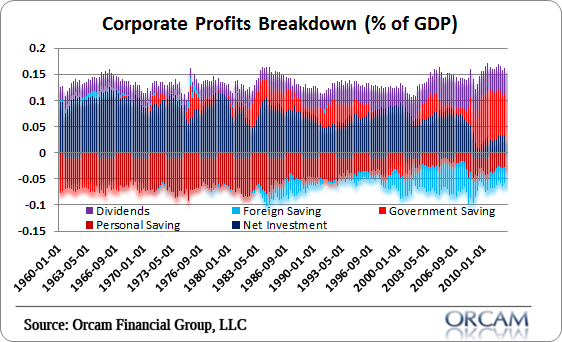
It might be easy to scoff at such an observation, but the reality of the picture is that corporate profits have been largely driven by the deficit in this cycle.  As net investment collapsed the traditional driver of profits was overtaken by government spending (see figure 1).  This makes sense if you're familiar with Kalecki and his profits equation.  It makes even more sense if you'd been working under Richard Koo's balance sheet recession theory in recent years.  The impact of government deficit spending in such an environment has been massive.  All those people screaming about the ill effects of deficit spending and hyperinflation in recent years missed the very explainable and fundamental driver of the profits momentum.

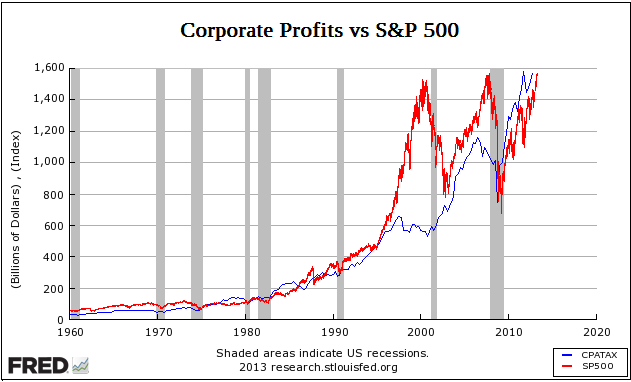
This doesn't mean QE did nothing (I think it helped to some degree), but it doesn't mean it was the primary driver of the recovery by any means.  In fact, the risk of QE is the disequilirbium I often talk of where market become disjointed when compared to profits.  And when people ask me if QE is resulting in some disequilibrium, I often tell them that it hasn't necessarily resulted in that outcome yet.  But with stocks rising nearly every day and soon outpacing the trajectory of corporate profits (see figure 2) there's no reason to think that we can't reach a level of disequilibrium in the next few years (or maybe even less).

mm1

(Figure 1 – Corporate Profits Breakdown via Orcam Investment Research)

cp

(Figure 2 – Corporate Profits vs S&P 500)


Sent from my iPhone