Sunday, April 28, 2013

Chart of the Day: Corporate Profits vs the S&P 500

Chart of the Day: Corporate Profits vs the S&P 500

I've made a big fuss over QE in recent years and yet the market continues to plough higher.  I often have people ask me:

"Why does QE make stock prices go higher if there's no fundamental impact?"

My answer is always the same.  First, look at Europe where QE has also been implemented and stock markets like Greece, Italy and Spain have been decimated.  Then look at a country like the USA where QE has been implemented and yet stocks soar.  Then ask yourself what the big difference is between these countries?  The answer: austerity versus massive deficit spending.

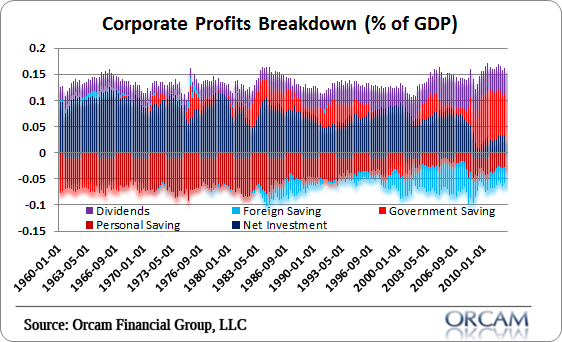
It might be easy to scoff at such an observation, but the reality of the picture is that corporate profits have been largely driven by the deficit in this cycle.  As net investment collapsed the traditional driver of profits was overtaken by government spending (see figure 1).  This makes sense if you're familiar with Kalecki and his profits equation.  It makes even more sense if you'd been working under Richard Koo's balance sheet recession theory in recent years.  The impact of government deficit spending in such an environment has been massive.  All those people screaming about the ill effects of deficit spending and hyperinflation in recent years missed the very explainable and fundamental driver of the profits momentum.

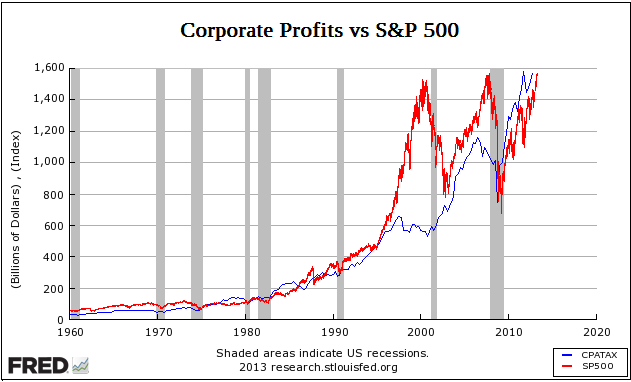
This doesn't mean QE did nothing (I think it helped to some degree), but it doesn't mean it was the primary driver of the recovery by any means.  In fact, the risk of QE is the disequilirbium I often talk of where market become disjointed when compared to profits.  And when people ask me if QE is resulting in some disequilibrium, I often tell them that it hasn't necessarily resulted in that outcome yet.  But with stocks rising nearly every day and soon outpacing the trajectory of corporate profits (see figure 2) there's no reason to think that we can't reach a level of disequilibrium in the next few years (or maybe even less).

mm1

(Figure 1 – Corporate Profits Breakdown via Orcam Investment Research)

cp

(Figure 2 – Corporate Profits vs S&P 500)


Sent from my iPhone

Thursday, April 25, 2013

When the Government Debits Our Bank Accounts….

When the Government Debits Our Bank Accounts….

I woke up to a not so lovely email this morning:

"There has been a large withdrawal from your bank account".

I won't joke around about what "large" is in my world because it's probably "small" in many other people's worlds, but that's beside the point.  The point is, that withdrawal was part of a very necessary flow of funds that precedes government spending.  After all, it was the US Treasury debiting my bank account.  Those of you who understand Monetary Realism know how important it is to understand the flow of funds in the economy.  The flow is the lifeblood.  It keeps revenues going, incomes going, spending going, etc.  No flow, no economy.  It's that simple.

The interesting part of the withdrawal I noticed this morning is that the government doesn't really need to withdraw money in order to be able to spend.  After all, it has deemed the US dollar as the unit of account in the USA and can create currency at will.  In theory, our government could just print dollar bills right into our bank accounts.  This was the true message of the Trillion Dollar Coin discussions.  Unfortunately, most commentators didn't even understand that.  Our government, if it wanted to, could just start crediting bank accounts without procuring the funds first.

But what really happens is due to specific bank centric design.  Our government has essentially outsourced the money supply to private banks.  So money creation starts when a bank makes a loan and money destruction occurs when a bank loan is repaid.  Between this start and finish are nothing more than a sequence of flows.

So, when the government taxes Peter they debit Peter's bank money (what Monteary Realism calls "inside money" because it comes from inside the private banking system), resulting in a credit to the government bank account so they can then debit the account and credit someone's account with inside money via government spending.  If they don't procure enough inside money they will sell bonds and again use the inside money system as an intermediary.  That is, if Peter buys a t-bond the government debits his inside money account, credits their account, credits Peter's account with a t-bond, and will eventually debit their account so they can credit someone else's account via government spending (notice the government doesn't "print money" when it taxes or sells bonds!).

As you can see, there's a specific flow of inside money that occurs.  Why?  Because the whole system is built around the stability of the inside money system.  It's all a flow of funds occurring in inside money and understanding that flow is crucial to understanding the modern monetary system.

* To learn more please see the following:

1.  Understanding The Modern Monetary System

2.  Understanding Inside & Outside Money

3.  Understanding Moneyness

4.  The Disaggregation of Credit


Sent from my iPad

On the virtuous circle of exporting deflation | FT Alphaville

On the virtuous circle of exporting deflation

We thought the following from TD Securities' Richard Gilhooly on Tuesday was a rather insightful way of looking at the whole BoJ effect (our emphasis):

While it remains a contentious point and as yet unproven, Japan's devaluation and soaring Nikkei vs slumping DAX or Bovespa has all the hallmarks of a competitive devaluation. While competing factions debate the Monetary expansion/QQE, versus beggar-thy-neighbour interpretation, one positive aspect of the Japanese Yen collapse and fear of exported deflation has been collapsing commodity prices with weak growth in export countries (China, Germany, S Korea) and a stronger USD helping a supply story (crude inventories at 22yr highs) and weak demand send commodities into a bear market.

The silver lining is that the collapse in inflation expectations may actually provide Germany/ECB with a motive to print to fight deflation and maybe even allow the Fed to print more and expand QE, versus expectations of tapering just 2 weeks ago with the minutes. The equity markets are again high on the sniff of QE adrenalin ahead of the FOMC and ECB next week, and the BOJ this Friday.

While the circularity of this argument is enough to make one's head spin, it appears for now to be a virtuous circle with rising equity prices emanating from slumping commodities. We argued last week that the drop in Gold prices was not bad for stocks and that the relationship is inverse and showed the inverse correlation since last November, falling Gold, surging stocks.

Volatility, we argued was the only reason for the short term positive correlation that lasted but 4 days. TIPs have seen a partial retracement of around 10bpp in b/es after a 30-40bp drop and more QE would appear to be a function of inflation (falling) rather than jobs (tapering) as long as the U/E rate is well over 6.5% and maybe even below if inflation remains 'dangerously' low.

Not that it is really dangerous, as displayed by the equity markets, but that the Central Bank-speak that allowed QE2 in 2010 to address that perilous risk. The upshot to all this is that stocks can't go down and probably go much higher (AAPL after hours) while $/Yen has quickly rebounded and probably breaks 100 this time, leaving bonds nowhere to go but down as today's reversal would indicate. Should a deflationary spiral materialise, which would only come after policies are deemed ineffective or inflation keeps falling to levels that are dangerous, then bonds might rally strongly, but this could only happen with cash flowing OUT of equities. Tomorrow's 5yr note auction is a good opportunity to buy 5s against bonds and a close over 220.5bp on 5-30s would strongly support this view.

The logic of the above is beautifully simple. Not that it's not been said before, but this really gets to the point we feel.

There is a stealth war on to export deflation, ideally in a way that simultaneously imports or steals inflation from elsewhere.

In some ways, it was the US which began the whole thing by inadvertently importing deflation from China over the 90s and naughties and without even realising it. And in so doing, it spread its growth effect to China.

Japan meanwhile has been trying to export its deflation for decades, with varying success. It is in some ways the original Patient Zero. The deflation it managed to export, however, has now created something of a zero sum game because it has led to other countries being forced to repel deflation in similar ways.

Consequently, we have left behind the world in which one man's deflation is another man's inflation. There is very little naturally occurring growth (the sort with good inflation) in the developed world left to capture.

There is of course a lot still left in the emerging market — but that unfortunately still has risk.

Before that risk is reduced the developed world has to reach such a point of wealth parity, that a united endeavour to spread wealth to the still risky areas of the world finally begins to make sense. That is, you get to the proverbial "nothing to lose" stage.

In the meantime, we continue the process of competitive devaluations and stimuli, which while being openly criticised by those with savings to be diluted, are more akin to a virtuous circle due to the wealth distribution effect they bring with it. This is because such easing efforts ensure the deflationary shock is diluted one country at a time, and that hoarded demand stubbornly held back elsewhere is tempted out, until something of a happy parity is reached amongst all. This is indeed something that's equivalent to a global stock dilution effect.

(In some ways, that was what Soros' idea to expand the global SDR allocation back in 2009 was all about.)

But as with all competitive devaluations/stimuli/deflation exports it now all depends on how the next most affected party responds. In the latest BoJ round it's clear that party is Germany, Japan's most obvious and natural competitor. Japan's current gain is understandably Germany's loss.

The question is will Germany overcome its totally unjustified inflation paranoia and act to counter the disadvantage?

If it doesn't the virtuous circle stands to collapse with Germany. In the first instance, that might not be a bad thing for Europe, because a German weakness only makes the periphery look more competitive and strong.

Everything after all is relative.

That said, we're not quite sure how good it would be for Europe in the long term, because even the periphery can't compete internationally if the euro is too strong.

Related links:
Japan 2.0 (and that's a target, mind) - FT Alphaville
In defence of sterling – FT Alphaville


Sent from my iPhone

Sunday, April 14, 2013

PRAGMATIC CAPITALISMChart of the Day: Corporate Profits vs the S&P 500 - PRAGMATIC CAPITALISM

Chart of the Day: Corporate Profits vs the S&P 500

I've made a big fuss over QE in recent years and yet the market continues to plough higher.  I often have people ask me:

"Why does QE make stock prices go higher if there's no fundamental impact?"

My answer is always the same.  First, look at Europe where QE has also been implemented and stock markets like Greece, Italy and Spain have been decimated.  Then look at a country like the USA where QE has been implemented and yet stocks soar.  Then ask yourself what the big difference is between these countries?  The answer: austerity versus massive deficit spending.

It might be easy to scoff at such an observation, but the reality of the picture is that corporate profits have been largely driven by the deficit in this cycle.  As net investment collapsed the traditional driver of profits was overtaken by government spending (see figure 1).  This makes sense if you're familiar with Kalecki and his profits equation.  It makes even more sense if you'd been working under Richard Koo's balance sheet recession theory in recent years.  The impact of government deficit spending in such an environment has been massive.  All those people screaming about the ill effects of deficit spending and hyperinflation in recent years missed the very explainable and fundamental driver of the profits momentum.

This doesn't mean QE did nothing (I think it helped to some degree), but it doesn't mean it was the primary driver of the recovery by any means.  In fact, the risk of QE is the disequilirbium I often talk of where market become disjointed when compared to profits.  And when people ask me if QE is resulting in some disequilibrium, I often tell them that it hasn't necessarily resulted in that outcome yet.  But with stocks rising nearly every day and soon outpacing the trajectory of corporate profits (see figure 2) there's no reason to think that we can't reach a level of disequilibrium in the next few years (or maybe even less).

mm1 Chart of the Day: Corporate Profits vs the S&P 500

(Figure 1 – Corporate Profits Breakdown via Orcam Investment Research)

cp Chart of the Day: Corporate Profits vs the S&P 500

(Figure 2 – Corporate Profits vs S&P 500)


Sent from my iPad

PRAGMATIC CAPITALISMHatzius: The Deficit Will Decline Substantially in the Coming Years - PRAGMATIC CAPITALISM

Hatzius: The Deficit Will Decline Substantially in the Coming Years

Jan Hatzius of Goldman Sachs had some interesting commentary on the deficit the other day.  You'll recognize the sectoral balances chart in his work as he's one of the few analysts on Wall Street who seems to really appreciate the importance of Wynne Godley's work.

Here, he describes the 3 reasons why the deficit is about to slide in the coming years:

Orcam ad4 Hatzius: The Deficit Will Decline Substantially in the Coming Years

"There are three main reasons for the sharp reduction in the deficit:

1. Lower spending. On a 12-month average basis, federal outlays have fallen by a total of 4% in the past two years, the first decline in nominal dollar terms over a comparable period since the demobilization from the Korean War in the mid-1950s.

2. Higher tax rates. The increase in payroll tax rates in January 2013 has boosted federal receipts by around $120 billion (annualized), or about 0.8% of GDP.

3. Economic improvement. Although real GDP has only grown at a sluggish 2%-2.5% pace since the end of the 2007-2009 recession, this has been enough to generate a sizable improvement in tax receipts, over and above the more recent impact of higher tax rates. Even prior to the tax hike that took effect in early 2013, total federal receipts had grown by 7% (annualized) from the 2009 bottom, nearly twice the growth rate of nominal GDP.

We expect the deficit to continue to decline and are forecasting a deficit of 3% of GDP or less in fiscal 2015. Some of this is policy-related. Sequestration has barely started to show up in the outlay data, and the expiration of the Bush tax cuts for high income earners in 2013 is likely to reduce tax refunds and boost final settlements in early 2014. In addition, the two parties are calling for further spending cuts and/or tax increases (although it is unclear whether these will be enacted).

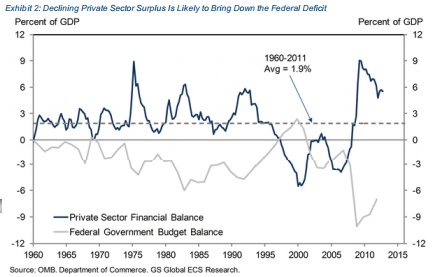
But the more important reason, in our view, is that there is still a great deal of room for the economic recovery to reduce the deficit for cyclical reasons. The key to this forecast is our expectation that the private sector financial surplus–the difference between the total income and total spending of all households and businesses–will decline substantially further from the 5.5% of GDP reading of the fourth quarter of 2012 toward the historical average of 2% of GDP.

As a matter of accounting, this reduction must be mirrored in a drop in the federal deficit, a drop in the state and local deficit, an increase in the current account deficit, or a combination of all three. In practice, however, we expect it to translate primarily into a decline in the federal deficit, as tax receipts rise and outlays decline (e.g. via reductions in the unemployment rolls.) This expectation is consistent with the historical record. As shown in Exhibit 2, there has been a close inverse relationship between the private sector balance and the federal government balance in recent decades, with a correlation in annual data of -0.72.

gs1 Hatzius: The Deficit Will Decline Substantially in the Coming Years

And the conclusion from Hatzius:

"In our view, the most important implication from the reduction in the budget deficit for the near-term economic outlook is reduced pressure for further fiscal retrenchment. Partly for this reason, we expect the drag from fiscal policy on real GDP growth to decline sharply from around 2% of GDP in 2013 to around 0.5% in coming years. This is a key reason for our expectation that real GDP growth will accelerate from around 2% (annualized) in Q2/Q3 2013 to 3%-3.5% in 2014-2016."

I'd only add that it's important that the private sector's de-leveraging is slowing and even turning into a re-leveraging to some degree.  This means the private sector is healthier than most presume and that the government deficit isn't needed to power private growth as much as it has been in the last few years.  This passing of the baton is important in understanding the future trajectory of the economy.  The decline in the deficit is as much as a result of mild government austerity as it is a sign of increased private sector health.


Sent from my iPad

Calafia Beach Pundit: Stocks and bonds are not at odds with each other

Stocks and bonds are not at odds with each other

I'm seeing more and more observers commenting on the apparent disconnect between the stock and bond markets. Reader "Rob" recently linked to a post by Thomas Kee at Smart Money that is typical. Kee argues that bond buyers these days are likely smarter than equity investors, because "they are educated and intelligent, and they make decisions for longer-term purposes." Whereas equity investors are more short-term focused ("fast money") and currently have been lulled into believing the recovery is real, when in fact it is "fabricated."

I think it's very difficult to defend the belief that one class of investors (bond buyers) see the world differently than another class (equity buyers), when both operate in the same capital market and both have access to the same information. To assert this, however, I need to show how it is that bond and equity investors today share similar beliefs about the economic fundamentals. If I'm right, then the "disconnect" is not really a disconnect, it's simply the result of how two very different asset classes react to the same information.


The chart above is a good illustration of the alleged "disconnect" between the stock and bond markets. Over the past three years, stock prices have been in a rising trend, while bond yields have been in a falling trend. That doesn't make sense, so the thinking goes, because falling bond yields are symptomatic of a market that is increasingly risk-averse, whereas rising equity prices are symptomatic of a market that is increasingly risk-loving. I think both interpretations are wrong.


As the first chart above shows, there is a decent correlation between the level of real yields and the strength of the economy. Real yields and real economic growth were both quite high in the late 1990s and early 2000s. The economy had been booming for several years, and the market expected this to continue. The real yield on TIPS had to compete with the very strong real yields on equities. This makes perfect sense. Now, over a decade later, real yields on TIPS are negative and the economy is in the midst of its weakest recovery ever, with a so-called "output gap" that could be as much as 13%. As the second chart shows, consumer confidence is extremely low; although it has risen in recent years, it is still at levels that in the past have coincided with recessions. The first chart suggests that the level of real yields is consistent with market expectations of almost zero growth for the next several years.


As the chart above shows, the equity risk premium—defined here as the difference between the earnings yield on equities minus the yield on 10-yr Treasuries—is extremely high. Why would the market be indifferent between an almost 5% earnings yield on equities and a paltry 1.7% yield on 10-yr Treasuries? The only explanation that makes sense is that the market has almost no confidence that corporate profits will maintain their current levels; instead, the market fully expects profits to decline significantly.


As the chart above shows, the earnings yield on equities tends to track inversely the real yield on TIPS. In other words, when real yields fall, as they have over the past decade, the earnings yield on equities has risen. The more gloomy the market becomes over the prospects for economic growth, the higher the equity yield that the market demands in compensation for what is expected to be a big decline in profits.  The two lines have diverged of late, and perhaps that is significant, but such divergences have happened before.


As the chart above shows, it is very unusual for the earnings yield on equities to be higher than the yield on BAA corporate bonds. Would you pass us the opportunity to buy stocks with a higher earnings yield than available on corporate bonds if you thought the economy was going to be healthy? No, because that would mean giving up the opportunity for price appreciation. Investors today are willing to accept a lower yield on corporate bonds because bonds are higher in the capital structure and have first claim to earnings, which the market suspects may be in for trouble.


But what about the fact that stock prices are at all-time highs? Doesn't that conflict with the fact that Treasury yields are close to all-time lows? Not necessarily. As the chart above shows, in inflation-adjusted terms the S&P 500 is still almost 25% below its 2000 all-time high. From a long-term perspective, the chart suggests that current equity prices are about "average," having followed a 3% trend growth rate, which happens to be the average real growth rate of the U.S. economy. Moreover, corporate profits today are almost 200% above the levels of late 2000. By these metrics, stocks are not optimistically priced at all. Today's S&P 500 PE ratio is just above 15, which is below its long-term average of 16. Shouldn't PE ratios be much higher than average considering that risk-free discount rates are at all-time lows?

Bonds and stocks are both priced to pessimistic assumptions about the future health of the U.S. economy, no matter how you look at it. And as for the assertion that the recovery has been "fabricated," I refer the reader back to many of my posts which show abundant evidence that many sectors of the economy are posting solid, undeniable growth, beginning with this recent post. This recovery may be the weakest ever, but it is no less real because of it.


Sent from my iPad

As Jerry Brown Touts California In China, Its Citizens Pack Their Bags - Forbes

http://www.forbes.com/sites/daviddavenport/2013/04/11/as-jerry-brown-touts-california-in-china-its-citizens-pack-their-bags/


Sent from my iPhone

Friday, March 29, 2013

The REAL Cult Of Equity | Macrofugue Analytics

The REAL Cult Of Equity

There has been a resurgence in recession calls after the past few months' soft data.  This is likely wrong.  None of the key recession-casting inputs (ISM: PMI 53.5, Real Retail Sales +3.5% y/y, Fixed Private Investment +10% y/y, Auto Sales +17.4%) signal US recession.

No great private imbalances exist.  There is no over-investment.  No great over-confidence in sentiment exists.  Marginal investment opportunities are fatter & juicier than at any other time in modern history.  With this back-drop, from where does a recession emerge?

Drawdown of PCE as a % of wages:

Unknownname

A nation does not spontaneously withdraw from working hard to pursue a better life for today (by consuming) and tomorrow (by investing).  The American dream is not dead: 82% of renters aged 25-34 want to own a house in the next 5 years, and that number represents a majority for every renting age group through 65.

As Conor Sen concluded in his June 25th piece, the capital structure impediments are receding into the a temporary demographic lull in housing bids.  The smaller Generation X has not been capable of picking up the slack left by the drying Boomer demand.  An under-appreciated fact is that the Millennial Generation is larger than the Boomers, and will likely be the largest and richest generation to walk the earth.

0unknownname

But even whilst we wait for the Millennial Generation to grow up and buy some houses, we are already seeing an emerging indication that the liquidation of housing inventory points to an end to the residential drag on GDP.  Since October of 2010, the pace of New One-Family Houses Sold has increased by 26.8%, and the Median Sale Price of New Homes Sold is up 14.8%.

1unknownname

This is not the sign of an economy that is teetering on recession.

Rather, the things that matter to the core economic engine of this country are on the up-swing.  Consider the Temporary Business & Professional payrolls, which substantially lead payrolls (and the economy) in aggregate:

2unknownname

It is much more difficult to forecast the marginal flows of economic activity (analog) than recession-casting (binary).  It seems unlikely that any one or institution has the ability to forecast whether we get 2% or 3% GDP to any degree of reliability.  Fortunately, for the moment, for the purposes of asset allocation, the extremes in valuation point to a very binary payoff.

3unknownname

We measure valuation here chiefly with two measurements of the Equity Risk Premium.  There are many different ways to measure it, but the most typical definition of the Equity Risk Premium is to subtract the 10-year US Treasury yield from the S&P 500 Earnings Yield (EY – 10y).  Whilst imperfect, previous plateaus and troughs in valuation have very neatly coincided with major turning-points in the US stock market.

The argument made against the Equity Risk Premium as calculated this way is that the Federal Reserve has artificially depressed the yields of risk-free instruments.  In order to present a view of the distorted premium on fixed cash-flows that the market has in an act of risk-aversion, rather than Fed intervention, we show a lesser-known measurement of the equity risk premium — the Levered Equity Risk Premium.  We calculate this by subtracting the Baa yield from the S&P 500 Earnings Yield (EY – Baa).  This premium on fixed cash-flows represents two markets the Federal Reserve does not participate in to form a more pure view.

If anything, it paints an even more convincing picture.  When LERP is at least 1.5%, the mean quarterly performance jumps from 1.6% to 2.76%.  Similarly, the mean 52-week return jumps from 8% to 15%.

Full sample When LERP >= 1.5%
6 month mean return 3.89% 8.23%
12 month mean return 7.9% 15.2%
24 month mean return 16.21% 28.85%
24 month minimum return -47.48% 6.28%

Perhaps what is most interesting – even more so than the roughly double average return expectancy – is the risk minimising effect buying at this extreme relative valuation threshold.

A combination of factors explain this out-performance.  The first, and most obvious, is the temporary and mean-reverting nature of risk-averse behaviour.  See the long-term chart of the bond:stock ratio with the S&P 500:

4unknownname

To solidify the view as to how mean-reverting this series really is, take this scatter-plot of the bond-stock ratio against forward 2-year returns:

5unknownname

Whilst imperfect, there is not much room for interpretation:  strong bids for bonds result in future equity gains.

The second supporting argument may be even more compelling:  whilst households tend to not correctly respond to economic incentives (evidenced by their herd-like behaviour in and out of asset classes), corporations rarely fail to take advantage of them.

The major driver is the cultural reverence for shareholders.  James Surowiecki wrote a piece in 2008 which contrasted Japanese with American business outcome optimisation.  He wrote:

In the 1990s, the average return on equity for the Nikkei was around four per cent, and in the second half of that decade and into the early years of this one it fell below two per cent. (In the U.S., the average R.O.E. is closer to eleven to twelve per cent.) According to this report, between 1998 and 2003, of all large-cap Japanese companies, only eight had an R.O.E. above ten per cent, which is a completely ordinary performance by U.S. standards. And even now, Japan's average R.O.E. is by far the lowest of any major economy.  What this means is that for much of the past two decades, Japanese companies have been destroying economic value for shareholders, using far more capital than they're generating.

And further on:

None of this is too surprising—historically, Japanese companies have been disdainful of the idea of shareholder value and of traditional profit metrics. In 1998, the chairman of Mitsubishi Heavy Industries famously said, "I openly brag that I don't cater to shareholders," and, even more amazingly, "We don't give a hoot about things like return on equity." In part, this is because companies' heavy reliance on debt financing and interlocking relationships meant that they felt they didn't need shareholders. It's also because many companies saw themselves as fulfilling a social role.

To accurately forecast the direction of security prices, we have to understand the motivations of the marginal players.  The purpose of capital, whether it's raised by debt or equity, is to seek a return.  Businesses have used external sources of capital for funding, which has provided them opportunity to spread the risk, and investors to achieve returns on their capital.

Fjiccdbc

Something curious has happened in the past decade, however:  the business sector has become nearly self-funded.  They have been so saturated with the capital from retained earnings that external capital is converging on non-essential for running operations.

Instead, the corporate sector has increasingly been using it to conduct capital structure arbitrage — taking advantage of the extremely cheap debt capital to reward the more expensive equity capital holders.  This is the true cult of equity.

Households will probably continue to shed their equities for fixed income instruments.  Hedge funds will probably continue to be both the tail and the dog (and probably make no money in aggregate:  it's tough being the marginal player!).  But it's the shareholders, ultimately, that constitute the boards.  Unlike Japan, even without the need for outside capital, the deified shareholder class is still the ultimate stakeholder to satisfy, and CFOs will respond to the most obvious and strong incentives.

Companies have been buying back stock for decades without any immediate economic incentive.  When the Levered Equity Risk Premium is positive, that means that corporations can borrow at a lower rate than their own shares are yielding.  While borrowing to fund buy-backs actually increases returns on equity, we can expect CFOs to do it.

The lull between the Baby Boomer & Millennial generations has provided a volatile environment to own equities, and has driven an extreme concentration in equity ownership.  While the volatility may not be over, this unique capital structure arbitrage opportunity has provided a cushion for those who are amassing assets to ultimately sell to Millennials as they grow up, get high paying jobs, and start investing for their future.


Sent from my iPad

Calafia Beach Pundit: Corporate profits remain strong

Corporate profits remain strong


With today's release of revised GDP stats for Q4/12, we got our first look at corporate profits for the period. Although after-tax profits failed to post another record high, they have been increasing at a much faster pace than the overall economy for more than a decade. Since the end of 2001, profits are up 161%, for an annualized gain of 9.1%. In contrast, nominal GDP has grown by only 3.9% per year over that same period. It's rather amazing. Corporate profits have exceeded almost everyone's wildest dreams: since the end of 2008, profits have more than doubled.

I remember calculating back then that the market was priced to the expectation that about one-fourth of U.S. corporations would be bankrupt within 5 years, and that corporate profits would decline by almost two-thirds. In short, the market was priced to an end-of-the-world-as-we-know-it scenario. But here we are 4 years later, and instead of a huge collapse in profits, we have seen a doubling of profits! This explains the rise in the stock market in the past 4 years, even as the recovery has been the most miserable one on record: the future has turned out to be much better than expected.

But still the market remains pessimistic, extremely reluctant to believe the good times will last. Why? Here's one explanation: As the second chart above shows, profits have averaged just over 6% of nominal GDP for the past 50 years or so, and that has created the expectation that profits will inevitably revert to that mean.


The above chart shows the PE ratio of the U.S. stock market using total after-tax, adjusted corporate profits from the National Income and Product Accounts as the "E" and the S&P 500 index as the "P." (I've used a normalized S&P 500 index to make the ratio similar on average to the actual PE ratio of the S&P 500, which averaged a little over 16 during this same period.) Note that this measure of the PE ratio of U.S. corporations at the end of last year was about 30% below its long-term average. With the S&P 500 today reaching its former all-time closing high, and assuming corporate profits have not grown at all this quarter, this PE ratio today would be 11.8, still about 25% below the long-term average.

By this measure, stocks today are extremely attractive. (The conventional calculation of the PE ratio of the S&P 500, using 12-month trailing earnings, is 15.4 today, about 7% below its long-term average.)

What explains the undervaluation of stocks today? I think it's the expectation that corporate profits will revert to their historical average of about 6-6.5%% of GDP. This might take the form of corporate profits declining by one-third in the near term, or not growing at all for the next 10 years while nominal GDP posts average growth. Either scenario would qualify as extremely pessimistic, albeit consistent with a mean-reversion of profits relative to GDP.


Once again I'll advance the notion that while corporate profits appear to be unsustainably high relative to the size of the U.S. economy, they are at fairly average levels when compared to the size of the world economy. The U.S. economy today is much more integrated with the rest of the world than ever before, and for most large corporations, international sales are an increasingly important source of total profits. The global economy has grown much faster than the U.S. economy in recent decades, so it is only natural that U.S. corporate profits have also grown much faster than the U.S. economy. There needn't be a big mean reversion; profits might even continue to grow, or at least not decline relative to nominal GDP in the future.

Conventional thinking sees unsustainably high corporate profits and expects a reversion to the mean. Global thinking sees no a priori reason to worry at all.


Sent from my iPad

Thursday, March 28, 2013

Redefining labour | FT Alphaville

Redefining labour

This is the third installment in FT Alphaville's "Beyond Scarcity" series, a somewhat radical look at the impact of technological progress and efficiency on the volume of goods and services being produced by the system, asking whether "abundance" could now be a key determinant of deflationary forces in the western world.

On top of this, we have considered the role played by "artificial scarcity", whether imposed wittingly or unwittingly by industry participants as a counterweight to such deflation, and to what degree such measures could now be running into scalability issues. In short, whether there is a limit to how much artificial scarcity private organisations can impose to counteract deflationary forces of abundance, without experiencing diminishing returns.

In our first installment we explained (in fuzzy felt) why an abundance of goods is naturally deflationary unless accompanied by equal or greater credit expansion. Furthermore, we explained why the process can eventually lead to the decay of money itself.

In our second installment we looked at why the private sector has an incentive to counteract such forces — which ultimately threaten profit itself by compromising monetary stores of value — by making things artificially scarce. Such measures can include everything from destocking, unemployment, and capacity shutdown to the accumulation of dark inventory.

Now we look at what technologically-induced abundance does to our understanding and treatment of productivity and labour in its own right.

We go straight to anthropologist and author David Graeber who conveniently penned "Of Flying Cars and the Declining Rate of Profit" this week, a fascinating analysis of why much of the technological innovation we imagined when we were young is still not here.

His point, very generally, is that technological progress is not on track — despite a mass perception that it is accelerating. That somewhere along the way it was sabotaged by those who had an interest in slowing it down.

Graeber notes, for example, the awkward relationship between technology, profitability and human labour:

Marx argued that, for certain technical reasons, value—and therefore profits—can be extracted only from human labor. Competition forces factory owners to mechanize production, to reduce labor costs, but while this is to the short-term advantage of the firm, mechanization's effect is to drive down the general rate of profit.

For 150 years, economists have debated whether all this is true. But if it is true, then the decision by industrialists not to pour research funds into the invention of the robot factories that everyone was anticipating in the sixties, and instead to relocate their factories to labor-intensive, low-tech facilities in China or the Global South makes a great deal of sense.

As I've noted, there's reason to believe the pace of technological innovation in productive processes—the factories themselves—began to slow in the fifties and sixties, but the side effects of America's rivalry with the Soviet Union made innovation appear to accelerate. There was the awesome space race, alongside frenetic efforts by U.S. industrial planners to apply existing technologies to consumer purposes, to create an optimistic sense of burgeoning prosperity and guaranteed progress that would undercut the appeal of working-class politics.

So while much of the West was fooled into thinking that technology was progressing more and more quickly — due to unfair comparisons with Soviet Union — in reality, the private sector was investing in outdated (but cheap) human labour abroad rather than improving mechanical industrial processes.

With the private sector failing to support technology — if not sabotaging it outright — it's no surprise then that real innovation was left to government entites, who were much less concerned about profitability.

Indeed as Graeber notes:

One reason we don't have robot factories is because roughly 95 percent of robotics research funding has been channeled through the Pentagon, which is more interested in developing unmanned drones than in automating paper mills.

This, Graeber argues, explains the type of technologies we've seen developed: technologies focused on surveillance, work discipline and social control rather than medical or humanitarian advances.

Graeber goes on to have some strong opinions about why technology, even now, is failing to advance as quickly as it should. He posits that neo-liberal and capitalist forces may be misdirecting innovation into bureacratic technologies, which awkwardly offset efficiencies, rather than focusing on the sort of grandiose poetic projects that could serve humanity (Mars missions etc), which we could have expected of the Soviets.

Nevertheless, one thing is clear. For the first time in decades, those in the know say private sector technology is outpacing government technology. Meanwhile, no matter how much of an incentive corporations may have to sabotage such efforts, technology appears increasingly to be slipping out of their control. This is thanks largely to open source initiatives and a system which increasingly provides for people at a base level. Once base needs are met — due to a general abundance of goods — however they may be funded, people are free to dedicate themselves, if they wish, to the pursuit of nobler goals, technologies and academia. On the academic front, despite the increasing trend towards tuition fees, access to knowledge has ironically never been cheaper.

True, internet tutorials are no replacement for a medical degree, but there are ever more fields in which an internet connection and a (good) will (hunting) to learn is all that's needed to achieve the same academic grounding as a college degree.

Peter Thiel, meanwhile, is even famously paying students to drop out of university altogether.

All these developments suggest that technological advances could soon start flowing back into production and manufacturing circles compromising the current corporate grip which is restraining abundance even further.

When human labour is almost completely replaced my mechanised robotics, even on the services front, it's fair to assume the cost of labour, production and profitability may have to be re-evaluated completely.

After all, if robots are doing most of our work, a high employment rate becomes illogical in society. In fact, it even makes sense for some portion of civilisation not to work at all or shift their productivity into different areas. Meanwhile, how can corporations justifiably continue to charge for goods and/or continue to waste products (or withhold products from the market) just in order to squeeze out profits?

Is this not the crisis of capitalism envisioned by both Keynes and Marx?

If the system is capable of free production — constrained only by energy costs and resources — a base level of existence can be increasingly provided free of charge to an ever growing amount of people.

Some will utilise this new-found freedom from labour –  and their ability to enjoy a growing abundance of goods — to pursue nobler goals (possibly ones which allow society to advance even further) which will allow the individual to achieve a greater than base existence. Others, meanwhile, will be able to just enjoy what the system provides (albeit at a base level), though at no cost or disadvantage to those who contribute to it. Some others, meanwhile, might instead be able to dedicate themselves to voluntary pursuits they could never have done before.

Many will be tempted to identify these developments as Marxist. We'd argue this is not the case. Rather, we'd say, this is the inevitable consequence of outsourcing labour to a body of non-sentient robotised slaves.

On the subject of the robotisation of the American workforce, Parag and Ayesha Khanna, co-directors of the Hybrid Reality Institute, who have a new book out this week entitled Hybrid Reality – a look ahead to a future where humans might even merge with technology — made the following observation in a Forbes editorial this month:

America's transition away from manufacturing was supposed to mean that we all move into a higher-value service economy – jobs which couldn't be lost to outsourcing. Technology was considered only an asset to productivity, not a liability to employment. Yet the most recent Q1 data reveals that unemployment is steady at around 8.1% not because workers have found jobs, but because hundreds of thousands of people – 342,000 in April alone – have left the workforce altogether. Retirees and those returning to school provide at best a partial accounting. Automation is a major factor. Today America needs 5 million less workers to produce a greater value of goods and services than it did in December 2007 when the recession began.

We think these are important trends.

Importantly, they support the theory that abundance is now a key driver of an irreversible and global deflationary spiral that few economists and investors have yet to account for. A deflation which ironically leads only to further technological process and abundance — and thus a future where the need for savings, and stores of value, is increasingly diminished.

One just needs to look at the example of Japan's economic malaise in the context of the technological, savings and monetary trends which have accompanied it.

What's more, as the Khannas also observe, in an environment where robotised labour leads to an ever greater abundance of goods quality products and services, those services which can filter through abundance or personalise it will remain the last remaining profit zones.

This not only explains the strength of the luxury goods sector throughout the crisis but the move towards increased self-incorporation in areas where a vendor or service provider's quality, personalised skill and reputation is increasingly appreciated over what corporates can offer (note the power of reputation on Ebay, the power of personalisation and craft on Etsy, and so on).

As the Khannas note:

More fundamentally, we can transition to an economy where we work more for ourselves, each other, and in teams. A logical consequence of the financial crisis but also one that could be construed as a silver lining is the rapidly growing rate of self-incorporation. Over one-third of Americans are now registered as self-employed, becoming small businesses in a P2P economy of professional services and retail, or sub-contractors in growing sectors such as healthcare and data collection and analysis.

Our last observations are these:

If it is true that the system can increasingly provide a base level of existence for ever more people for almost no cost, should we be surprised that those western countries where a base level of existence is adequate — because of weather, surroundings and general environment — are the first to opt out of unnecessary human productivity?

Could the remarkable comeback of economies like Iceland post-bankruptcy be testament to the innate productivity of the system? Iceland's credit has already started to recover, a trend which suggests default stigma is much less important than you'd expect it to be.

Does bankruptcy even matter in an age of real abundance?

Might bankruptcy help to quash artificial scarcity, encouraging greater abundance and efficiencies, as people begin to see the merits of working for free?

Detractors of the theory will point to energy and resource constraints. But it's arguable that as more and more states are frozen out of global commerce they will increasingly look to each other to create their own barter-focused supply chains servicing their needs.

Meanwhile, there is some evidence to suggest that today's energy constraints are already not what they used to be. This is in part thanks to technological advances in such things as shale gas and is clearly demonstrated by the explosion of the natgas to oil ratio, the difference in the price of an energy resource which is routinely manipulated by a cartel around an artificial scarcity agenda and one which cannot be as easily bound in the same way.

We'll leave the discussion open.

We are keen, as ever, to hear your thoughts.


Sent from my iPad