Tuesday, December 18, 2012

RealClearMarkets - Enlisting EA Sports To Save Us From the Federal Reserve

Enlisting EA Sports To Save Us From the Federal Reserve

As most readers know, EA Sports is the wildly successful creator of home video games that allow the sports fan to "coach" his or her team of choice. Along somewhat similar lines, Fantasy Football leagues offer the same fan the chance to act as general manager.

The beauty of both is that any damage is limited to the individual. Whatever the vanity or ego of the participant, bold ideas about how to win at Madden 2012 or in the office fantasy pool don't harm the innocent.

The same can't be said for the vain actions of the Ben Bernanke-led Federal Reserve. Bernanke combines a stunning lack of self-awareness with a tragically arrogant sense of genius that has him performing myriad experiments backed by the deep-pocketed Fed; the difference here that Bernanke's medicinals make us all ill.

Regarding last week's Fed meeting and the subsequent floating of the Fed's latest plan of action, frightened readers can at least be confident that it won't work. Implicit in Bernanke's promise that the Fed will cease buying bonds when the unemployment rate reaches 6.5% is the not-so-hidden truth that so long as Bernanke's at the Fed, quantitative easing will be the rule.

That's the case given the inescapable reality that there are no jobs without investment first. Just as capital gains taxes are a barrier to investment for them reducing any potential returns, the devaluation of the dollar which is the goal of quantitative easing is a similar tax on the investment that leads to company formation and hiring. Job-creating investors are buying future dollar income streams, and devaluation is a deterrent.

Put plainly, quantitative easing will continue because it's anti-job creation. At best, and this assumes the previously made predictions are wrong, 6.5% unemployment will be "achieved" for driving down the real cost of labor so much that hiring becomes incredibly cheap. In short, QE will only work insofar as it makes the paychecks earned from labor extraordinarily unattractive.

Considering the alleged wrinkle whereby Bernanke says he will tie QE to the rate unemployment, here he's simply acknowledging what's always been true about him being wedded to the Phillips Curve. The latter model suggests that economic growth is the driver of inflation; Bernanke's point with 6.5% unemployment that anything below it will stoke the flames of inflation.

The problem there is that Phillips Curve thinking is completely bogus; so bogus that any reader could with a few minutes of thought explain why low unemployment would in no way drive up inflation. If any reader is stuck, below is a quick explanation:

Whether I'm buying a movie ticket, plane ticket, filling my car with gasoline made expensive by policies in favor of devaluation, or depositing an increasingly devalued paycheck at the bank, I never anymore deal with a live human being. Thanks to innovations of the free market variety, the wage pressures presumed by Bernanke's Phillips Curve model have been rendered meaningless.

Assuming no innovation, and the Fed's devaluations tautologically signal less innovation (remember, entrepreneurs are reliant on investment), there would still be no wage pressures wrought by low unemployment in the States. That is so precisely because the United States is not an island. Instead, producers here interact with the global labor force, and any labor shortages stateside will be erased by eager workers who don't reside in these fifty states. To offer up but one of countless examples, Boeing's 787 Dreamliner is presently being manufactured in seven different countries around the world.

The Bernanke Fed falsely believes that inflation is caused by too much growth, but the reality is the opposite. A strong dollar is the antithesis of inflation, it's what attracts investment, and investment is what brings unemployment down. One reason unemployment is high today has to with the fact that the dollar is very weak (think inflationary - gasoline and food costs are spiking for a reason), and the weak dollar once again is a repellent to job-creating investment.

Back to a non-sports way for EA Sports to save us from the Fed, how about manufacturing a video game for the central bankers and their enablers in the economics profession whose machinations so cruelly weigh on economic growth? Anything to occupy their minds so that they stop causing so much damage.

To keep them engaged, EA's designers could even tweak the game so that quite unlike the real world where adolescent attempts to stimulate growth through the buying of bonds never work, in the EA competition they would. EA Sports is ultimately its own fantasy whereby someone good with a joystick can achieve outcomes that never reveal themselves on the field (think the Detroit Lions winning the Super Bowl), so why not craft EA Quantitative Easing in which the winners print money?  Quantitative easing is surely the policy of the adolescent, adolescents reside in a "Everyone Gets a Trophy" world, so why not give the perennial losers at the Fed a chance to actually "win" something?   

If so, the mad scientists of the economics profession who foist on us their juvenile musings about "credit creation" and growth will do so in a controlled setting whereby their immaturity will only harm them. Just as the unskilled Madden 2012 player will make the New England Patriots look bad without harming the actual Patriots, delusional economists who regularly make the simple (economics) difficult will no longer victimize all of us with their confusion.

Sadly, what's proposed here is a fantasy. Back in reality, the individuals who comprise the U.S. and global economy will continue to suffer Ben Bernanke's totally discredited solutions to what ails us. But let's not fret. Bernanke's failures are his undoing. From his naivete will eventually emerge monetary normalcy.


Sent from my iPhone

Monday, December 17, 2012

Instapundit » Blog Archive » SO IF WE’RE GOING TO HAVE A “NATIONAL CONVERSATION ON GUNS,” HERE ARE SOME OPENERS: Why do people…

DECEMBER 17, 2012

SO IF WE'RE GOING TO HAVE A "NATIONAL CONVERSATION ON GUNS," HERE ARE SOME OPENERS:

Why do people who favor gun-control call people who disagree with them murderers or accomplices to murder? Is that constructive?

Would any of the various proposals have actually prevented the tragedy that is the supposed reason for them?

When you say you hope that this event will finally change the debate, do you really mean that you hope you can use emotionalism and blood-libel-bullying to get your way on political issues that were losers in the past?

If you're a media member or politician, do you have armed security? Do you have a permit for a gun yourself? (I'm asking you Dianne Feinstein!) If so, what makes your life more valuable than other people's?

Do you know the difference between an automatic weapon and a semi-automatic weapon? Do your public statements reflect that difference?

If guns cause murder, why have murder rates fallen as gun sales have skyrocketed?

Have you talked about "Fast and Furious?" Do you even know what it is? Do you care less when brown people die?

When you say that "we" need to change, how are you planning to change? Does your change involve any actual sacrifice on your part?

Let me know when you're ready to talk about these things. We'll have a conversation.

UPDATE: John Lucas emails:

Joe Scarborough, who claims to be a "proud NRA member" just said there is no reason to allow someone to have an "assault weapon" that shoots "30 rounds a second."

The ignorance is appalling.

Well, yes. It's MSNBC. But it is interesting that Scarborough — like Mark Shields and Rupert Murdoch — seems entirely ignorant of actual gun law. But to be fair, the National Firearms Act has only been around since 1934.


Sent from my iPhone

Sunday, December 16, 2012

The End of the University as We Know It - Nathan Harden - The American Interest Magazine

The End of the University as We Know It - Nathan Harden - The American Interest Magazine

In fifty years, if not much sooner, half of the roughly 4,500 colleges and universities now operating in the United States will have ceased to exist. The technology driving this change is already at work, and nothing can stop it. The future looks like this: Access to college-level education will be free for everyone; the residential college campus will become largely obsolete; tens of thousands of professors will lose their jobs; the bachelor's degree will become increasingly irrelevant; and ten years from now Harvard will enroll ten million students.

We've all heard plenty about the "college bubble" in recent years. Student loan debt is at an all-time high—an average of more than $23,000 per graduate by some counts—and tuition costs continue to rise at a rate far outpacing inflation, as they have for decades. Credential inflation is devaluing the college degree, making graduate degrees, and the greater debt required to pay for them, increasingly necessary for many people to maintain the standard of living they experienced growing up in their parents' homes. Students are defaulting on their loans at an unprecedented rate, too, partly a function of an economy short on entry-level professional positions. Yet, as with all bubbles, there's a persistent public belief in the value of something, and that faith in the college degree has kept demand high.

The figures are alarming, the anecdotes downright depressing. But the real story of the American higher-education bubble has little to do with individual students and their debts or employment problems. The most important part of the college bubble story—the one we will soon be hearing much more about—concerns the impending financial collapse of numerous private colleges and universities and the likely shrinkage of many public ones. And when that bubble bursts, it will end a system of higher education that, for all of its history, has been steeped in a culture of exclusivity. Then we'll see the birth of something entirely new as we accept one central and unavoidable fact: The college classroom is about to go virtual. 

W

e are all aware that the IT revolution is having an impact on education, but we tend to appreciate the changes in isolation, and at the margins. Very few have been able to exercise their imaginations to the point that they can perceive the systemic and structural changes ahead, and what they portend for the business models and social scripts that sustain the status quo. That is partly because the changes are threatening to many vested interests, but also partly because the human mind resists surrender to upheaval and the anxiety that tends to go with it. But resist or not, major change is coming. The live lecture will be replaced by streaming video. The administration of exams and exchange of coursework over the internet will become the norm. The push and pull of academic exchange will take place mainly in interactive online spaces, occupied by a new generation of tablet-toting, hyper-connected youth who already spend much of their lives online. Universities will extend their reach to students around the world, unbounded by geography or even by time zones. All of this will be on offer, too, at a fraction of the cost of a traditional college education. 

How do I know this will happen? Because recent history shows us that the internet is a great destroyer of any traditional business that relies on the sale of information. The internet destroyed the livelihoods of traditional stock brokers and bonds salesmen by throwing open to everyone access to the proprietary information they used to sell. The same technology enabled bankers and financiers to develop new products and methods, but, as it turned out, the experience necessary to manage it all did not keep up. Prior to the Wall Street meltdown, it seemed absurd to think that storied financial institutions like Bear Stearns and Lehman Brothers could disappear seemingly overnight. Until it happened, almost no one believed such a thing was possible. Well, get ready to see the same thing happen to a university near you, and not for entirely dissimilar reasons. 

The higher-ed business is in for a lot of pain as a new era of creative destruction produces a merciless shakeout of those institutions that adapt and prosper from those that stall and die. Meanwhile, students themselves are in for a golden age, characterized by near-universal access to the highest quality teaching and scholarship at a minimal cost. The changes ahead will ultimately bring about the most beneficial, most efficient and most equitable access to education that the world has ever seen. There is much to be gained. We may lose the gothic arches, the bespectacled lecturers, dusty books lining the walls of labyrinthine libraries—wonderful images from higher education's past. But nostalgia won't stop the unsentimental beast of progress from wreaking havoc on old ways of doing things. If a faster, cheaper way of sharing information emerges, history shows us that it will quickly supplant what came before. People will not continue to pay tens of thousands of dollars for what technology allows them to get for free.

Technology will also bring future students an array of new choices about how to build and customize their educations. Power is shifting away from selective university admissions officers into the hands of educational consumers, who will soon have their choice of attending virtually any university in the world online. This will dramatically increase competition among universities. Prestigious institutions, especially those few extremely well-endowed ones with money to buffer and finance change, will be in a position to dominate this virtual, global educational marketplace. The bottom feeders—the for-profit colleges and low-level public and non-profit colleges—will disappear or turn into the equivalent of vocational training institutes. Universities of all ranks below the very top will engage each other in an all-out war of survival. In this war, big-budget universities carrying large transactional costs stand to lose the most. Smaller, more nimble institutions with sound leadership will do best. 

T

his past spring, Harvard and MIT got the attention of everyone in the higher ed business when they announced a new online education venture called edX. The new venture will make online versions of the universities' courses available to a virtually unlimited number of enrollees around the world. Think of the ramifications: Now anyone in the world with an internet connection can access the kind of high-level teaching and scholarship previously available only to a select group of the best and most privileged students. It's all part of a new breed of online courses known as "massive open online courses" (MOOCs), which are poised to forever change the way students learn and universities teach.

One of the biggest barriers to the mainstreaming of online education is the common assumption that students don't learn as well with computer-based instruction as they do with in-person instruction. There's nothing like the personal touch of being in a classroom with an actual professor, says the conventional wisdom, and that's true to some extent. Clearly, online education can't be superior in all respects to the in-person experience. Nor is there any point pretending that information is the same as knowledge, and that access to information is the same as the teaching function instrumental to turning the former into the latter. But researchers at Carnegie Mellon's Open Learning Initiative, who've been experimenting with computer-based learning for years, have found that when machine-guided learning is combined with traditional classroom instruction, students can learn material in half the time. Researchers at Ithaka S+R studied two groups of students—one group that received all instruction in person, and another group that received a mixture of traditional and computer-based instruction. The two groups did equally well on tests, but those who received the computer instruction were able to learn the same amount of material in 25 percent less time.

The real value of MOOCs is their scalability. Andrew Ng, a Stanford computer science professor and co-founder of an open-source web platform called Coursera (a for-profit version of edX), got into the MOOC business after he discovered that thousands of people were following his free Stanford courses online. He wanted to capitalize on the intense demand for high-quality, open-source online courses. A normal class Ng teaches at Stanford might enroll, at most, several hundred students. But in the fall of 2011 his online course in machine learning enrolled 100,000. "To reach that many students before", Ng explained to Thomas Friedman of the New York Times, "I would have had to teach my normal Stanford class for 250 years."

Based on the popularity of the MOOC offerings online so far, we know that open-source courses at elite universities have the potential to serve enormous "classes." An early MIT online course called "Circuits and Electronics" has attracted 120,000 registrants. Top schools like Yale, MIT and Stanford have been making streaming videos and podcasts of their courses available online for years, but MOOCs go beyond this to offer a full-blown interactive experience. Students can intermingle with faculty and with each other over a kind of higher-ed social network. Streaming lectures may be accompanied by short auto-graded quizzes. Students can post questions about course material to discuss with other students. These discussions unfold across time zones, 24 hours a day. In extremely large courses, students can vote questions up or down, so that the best questions rise to the top. It's like an educational amalgam of YouTube, Wikipedia and Facebook.

Among the chattering classes in higher ed, there is an increasing sense that we have reached a tipping point where new interactive web technology, coupled with widespread access to broadband internet service and increased student comfort interacting online, will send online education mainstream. It's easy to forget that only ten years ago Facebook didn't exist. Teens now approaching college age are members of the first generation to have grown up conducting a major part of their social lives online. They are prepared to engage with professors and students online in a way their predecessors weren't, and as time passes more and more professors are comfortable with the technology, too.

In the future, the primary platform for higher education may be a third-party website, not the university itself. What is emerging is a global marketplace where courses from numerous universities are available on a single website. Students can pick and choose the best offerings from each school; the university simply uploads the content. Coursera, for example, has formed agreements with Penn, Princeton, UC Berkeley, and the University of Michigan to manage these schools' forays into online education. On the non-profit side, MIT has been the nation's leader in pioneering open-source online education through its MITx platform, which launched last December and serves as the basis for the new edX platform. 

H

old on there a minute, you might object. Just as information is not the same as knowledge, and auto-access is not necessarily auto-didactics, so taking a bunch of random courses does not a coherent university education make. Mere exposure, too, doesn't guarantee that knowledge has been learned. In other words, what about the justifiable function of majors and credentials?

MIT is the first elite university to offer a credential for students who complete its free, open-source online courses. (The certificate of completion requires a small fee.) For the first time, students can do more than simply watch free lectures; they can gain a marketable credential—something that could help secure a raise or a better job. While edX won't offer traditional academic credits, Harvard and MIT have announced that "certificates of mastery" will be available for those who complete the online courses and can demonstrate knowledge of course material. The arrival of credentials, backed by respected universities, eliminates one of the last remaining obstacles to the widespread adoption of low-cost online education. Since edX is open source, Harvard and MIT expect other universities to adopt the same platform and contribute their own courses. And the two universities have put $60 million of their own money behind the project, making edX the most promising MOOC venture out there right now.

Anant Agarwal, an MIT computer science professor and edX's first president, told the Los Angeles Times, "MIT's and Harvard's mission is to provide affordable education to anybody who wants it." That's a very different mission than elite schools like Harvard and MIT have had for most of their existence. These schools have long focused on educating the elite—the smartest and, often, the wealthiest students in the world. But Agarwal's statement is an indication that, at some level, these institutions realize that the scalability and economic efficiency of online education allow for a new kind of mission for elite universities. Online education is forcing elite schools to re-examine their priorities. In the future, they will educate the masses as well as the select few. The leaders of Harvard and MIT have founded edX, undoubtedly, because they realize that these changes are afoot, even if they may not yet grasp just how profound those changes will be. 

And what about the social experience that is so important to college? Students can learn as much from their peers in informal settings as they do from their professors in formal ones. After college, networking with fellow alumni can lead to valuable career opportunities. Perhaps that is why, after the launch of edX, the presidents of both Harvard and MIT emphasized that their focus would remain on the traditional residential experience. "Online education is not an enemy of residential education", said MIT president Susan Hockfield.

Yet Hockfield's statement doesn't hold true for most less wealthy universities. Harvard and MIT's multi-billion dollar endowments enable them to support a residential college system alongside the virtually free online platforms of the future, but for other universities online education poses a real threat to the residential model. Why, after all, would someone pay tens of thousands of dollars to attend Nowhere State University when he or she can attend an online version of MIT or Harvard practically for free?

This is why those middle-tier universities that have spent the past few decades spending tens or even hundreds of millions to offer students the Disneyland for Geeks experience are going to find themselves in real trouble. Along with luxury dorms and dining halls, vast athletic facilities, state of the art game rooms, theaters and student centers have come layers of staff and non-teaching administrators, all of which drives up the cost of the college degree without enhancing student learning. The biggest mistake a non-ultra-elite university could make today is to spend lavishly to expand its physical space. Buying large swaths of land and erecting vast new buildings is an investment in the past, not the future. Smart universities should be investing in online technology and positioning themselves as leaders in the new frontier of open-source education. Creating the world's premier, credentialed open online education platform would be a major achievement for any university, and it would probably cost much less than building a new luxury dorm.

Even some elite universities may find themselves in trouble in this regard, despite their capacity, as noted, to retain the residential norm. In 2007 Princeton completed construction on a new $136 million luxury dormitory for its students—all part of an effort to expand its undergraduate enrollment. Last year Yale finalized plans to build new residential dormitories at a combined cost of $600 million. The expansion will increase the size of Yale's undergraduate population by about 1,000. The project is so expensive that Yale could actually buy a three-bedroom home in New Haven for every new student it is bringing in and still save $100 million. In New York City, Columbia stirred up controversy by seizing entire blocks of Harlem by force of eminent domain for a project with a $6.3 billion price tag. Not to be outdone, Columbia's downtown neighbor, NYU, announced plans to buy up six million square feet of debt-leveraged space in one of the most expensive real estate markets in the world, at an estimated cost of $6 billion. The University of Pennsylvania has for years been expanding all over West Philadelphia like an amoeba gone real-estate insane. What these universities are doing is pure folly, akin to building a compact disc factory in the late 1990s. They are investing in a model that is on its way to obsolescence. If these universities understood the changes that lie ahead, they would be selling off real estate, not buying it—unless they prefer being landlords to being educators.

Now, because the demand for college degrees is so high (whether for good reasons or not is not the question for the moment), and because students and the parents who love them are willing to take on massive debt in order to obtain those degrees, and because the government has been eager to make student loans easier to come by, these universities and others have, so far, been able to keep on building and raising prices. But what happens when a limited supply of a sought-after commodity suddenly becomes unlimited? Prices fall. Yet here, on the cusp of a new era of online education, that is a financial reality that few American universities are prepared to face.

The era of online education presents universities with a conflict of interests—the goal of educating the public on one hand, and the goal of making money on the other. As Burck Smith, CEO of the distance-learning company StraighterLine, has written, universities have "a public-sector mandate" but "a private-sector business model." In other words, raising revenues often trumps the interests of students. Most universities charge as much for their online courses as they do for their traditional classroom courses. They treat the savings of online education as a way to boost profit margins; they don't pass those savings along to students.

One potential source of cost savings for lower-rung colleges would be to draw from open-source courses offered by elite universities. Community colleges, for instance, could effectively outsource many of their courses via MOOCs, becoming, in effect, partial downstream aggregators of others' creations, more or less like newspapers have used wire services to make up for a decline in the number of reporters. They could then serve more students with fewer faculty, saving money for themselves and students. At a time when many public universities are facing stiff budget cuts and families are struggling to pay for their kids' educations, open-source online education looks like a promising way to reduce costs and increase the quality of instruction. Unfortunately, few college administrators are keen on slashing budgets, downsizing departments or taking other difficult steps to reduce costs. The past thirty years of constant tuition hikes at U.S. universities has shown us that much. 

The biggest obstacle to the rapid adoption of low-cost, open-source education in America is that many of the stakeholders make a very handsome living off the system as is. In 2009, 36 college presidents made more than $1 million. That's in the middle of a recession, when most campuses were facing severe budget cuts. This makes them rather conservative when it comes to the politics of higher education, in sharp contrast to their usual leftwing political bias in other areas. Reforming themselves out of business by rushing to provide low- and middle-income students credentials for free via open-source courses must be the last thing on those presidents' minds.

Nevertheless, competitive online offerings from other schools will eventually force these "non-profit" institutions to embrace the online model, even if the public interest alone won't. And state governments will put pressure on public institutions to adopt the new open-source model, once politicians become aware of the comparable quality, broad access and low cost it offers.

C

onsidering the greater interactivity and global connectivity that future technology will afford, the gap between the online experience and the in-person experience will continue to close. For a long time now, the largest division within Harvard University has been the little-known Harvard Extension School, a degree-granting division within the Faculty of Arts and Sciences with minimal admissions standards and very low tuition that currently enrolls 13,000 students. The Extension School was founded for the egalitarian purpose of making the Harvard education available to the masses. Nevertheless, Harvard took measures to protect the exclusivity of its brand. The undergraduate degrees offered by the Extension School (Bachelor of Liberal Arts) are distinguished by name from the degrees the university awards through Harvard College (Bachelor of Arts). This model—one university, two types of degrees—offers a good template for Harvard's future, in which the old residential college model will operate parallel to the new online open-source model. The Extension School already offers more than 200 online courses for full academic credit.

Prestigious private institutions and flagship public universities will thrive in the open-source market, where students will be drawn to the schools with bigger names. This means, paradoxically, that prestigious universities, which will have the easiest time holding on to the old residential model, also have the most to gain under the new model. Elite universities that are among the first to offer robust academic programs online, with real credentials behind them, will be the winners in the coming higher-ed revolution.

There is, of course, the question of prestige, which implies selectivity. It's the primary way elite universities have distinguished themselves in the past. The harder it is to get in, the more prestigious a university appears. But limiting admissions to a select few makes little sense in the world of online education, where enrollment is no longer bounded by the number of seats in a classroom or the number of available dorm rooms. In the online world, the only concern is having enough faculty and staff on hand to review essays, or grade the tests that aren't automated, or to answer questions and monitor student progress online.

Certain valuable experiences will be lost in this new online era, as already noted. My own experience at Yale furnishes some specifics. Through its "Open Yale" initiative, Yale has been recording its lecture courses for several years now, making them available to the public free of charge. Anyone with an internet connection can go online and watch some of the same lectures I attended as a Yale undergrad. But that person won't get the social life, the long chats in the dinning hall, the feeling of collegiality, the trips around Long Island sound with the sailing team, the concerts, the iron-sharpens-iron debates around the seminar table, the rare book library, or the famous guest lecturers (although some of those events are streamed online, too). On the other hand, you can watch me and my fellow students take the stage to demonstrate a Hoplite phalanx in Donald Kagan's class on ancient Greek history. You can take a virtual seat next to me in one of Giuseppe Mazzota's unforgettable lectures on The Divine Comedy.

So while it can never duplicate the experience of a student with the good fortune to get into Yale, this is an historically significant development. Anyone who can access the internet—at a public library, for instance—no matter how poor or disadvantaged or isolated or uneducated he or she may be, can access the teachings of some of the greatest scholars of our time through open course portals. Technology is a great equalizer. Not everyone is willing or capable of taking advantage of these kinds of resources, but for those who are, the opportunity is there. As a society, we are experiencing a broadening of access to education equal in significance to the invention of the printing press, the public library or the public school.

O

nline education is like using online dating websites—fifteen years ago it was considered a poor substitute for the real thing, even creepy; now it's ubiquitous. Online education used to have a stigma, as if it were inherently less rigorous or less effective. Eventually for-profit colleges and public universities, which had less to lose in terms of snob appeal, led the charge in bringing online education into the mainstream. It's very common today for public universities to offer a menu of online courses to supplement traditional courses. Students can be enrolled in both types of courses simultaneously, and can sometimes even be enrolled in traditional classes at one university while taking an online course at another. 

The open-source marketplace promises to offer students additional choices in the way they build their credentials. Colleges have long placed numerous restrictions on the number of credits a student can transfer in from an outside institution. In many cases, these restrictions appear useful for little more than protecting the university's bottom line. The open-source model will offer much more flexibility, though still maintain the structure of a major en route to obtaining a credential. Students who aren't interested in pursuing a traditional four-year degree, or in having any major at all, will be able to earn meaningful credentials one class at a time.

To borrow an analogy from the music industry, universities have previously sold education in an "album" package—the four-year bachelor's degree in a certain major, usually coupled with a core curriculum. The trend for the future will be more compact, targeted educational certificates and credits, which students will be able to pick and choose from to create their own academic portfolios. Take a math class from MIT, an engineering class from Purdue, perhaps with a course in environmental law from Yale, and create interdisciplinary education targeted to one's own interests and career goals. Employers will be able to identify students who have done well in specific courses that match their needs. When people submit résumés to potential employers, they could include a list of these individual courses, and their achievement in them, rather than simply reference a degree and overall GPA. The legitimacy of MOOCs in the eyes of employers will grow, then, as respected universities take the lead in offering open courses with meaningful credentials.

MOOCs will also be a great remedy to the increasing need for continuing education. It's worth noting that while the four-year residential experience is what many of us picture when we think of "college", the residential college experience has already become an experience only a minority of the nation's students enjoy. Adult returning students now make up a large mass of those attending university. Non-traditional students make up 40 percent of all college students. Together with commuting students, or others taking classes online, they show that the traditional residential college experience is something many students either can't afford or want. The for-profit colleges, which often cater to working adult students with a combination of night and weekend classes and online coursework, have tapped into the massive demand for practical and customized education. It's a sign of what is to come.

W

hat about the destruction these changes will cause? Think again of the music industry analogy. Today, when you drive down music row in Nashville, a street formerly dominated by the offices of record labels and music publishing companies, you see a lot of empty buildings and rental signs. The contraction in the music industry has been relentless since the Mp3 and the iPod emerged. This isn't just because piracy is easier now; it's also because consumers have been given, for the first time, the opportunity to break the album down into individual songs. They can purchase the one or two songs they want and leave the rest. Higher education is about to become like that. 

For nearly a thousand years the university system has looked just about the same: professors, classrooms, students in chairs. The lecture and the library have been at the center of it all. At its best, traditional classroom education offers the chance for intelligent and enthusiastic students to engage a professor and one another in debate and dialogue. But typical American college education rarely lives up to this ideal. Deep engagement with texts and passionate learning aren't the prevailing characteristics of most college classrooms today anyway. More common are grade inflation, poor student discipline, and apathetic teachers rubber-stamping students just to keep them paying tuition for one more term. 

If you ask students what they value most about the residential college experience, they'll often speak of the unique social experience it provides: the chance to live among one's peers and practice being independent in a sheltered environment, where many of life's daily necessities like cooking and cleaning are taken care of. It's not unlike what summer camp does at an earlier age. For some, college offers the chance to form meaningful friendships and explore unique extracurricular activities. Then, of course, there are the Animal House parties and hookups, which do take their toll: In their research for their book Academically Adrift, Richard Arum and Josipa Roksa found that 45 percent of the students they surveyed said they had no significant gains in knowledge after two years of college. Consider the possibility that, for the average student, traditional in-classroom university education has proven so ineffective that an online setting could scarcely be worse. But to recognize that would require unvarnished honesty about the present state of play. That's highly unlikely, especially coming from present university incumbents. 

The open-source educational marketplace will give everyone access to the best universities in the world. This will inevitably spell disaster for colleges and universities that are perceived as second rate. Likewise, the most popular professors will enjoy massive influence as they teach vast global courses with registrants numbering in the hundreds of thousands (even though "most popular" may well equate to most entertaining rather than to most rigorous). Meanwhile, professors who are less popular, even if they are better but more demanding instructors, will be squeezed out. Fair or not, a reduction in the number of faculty needed to teach the world's students will result. For this reason, pursuing a Ph.D. in the liberal arts is one of the riskiest career moves one could make today. Because much of the teaching work can be scaled, automated or even duplicated by recording and replaying the same lecture over and over again on video, demand for instructors will decline. 

Who, then, will do all the research that we rely on universities to do if campuses shrink and the number of full-time faculty diminishes? And how will important research be funded? The news here is not necessarily bad, either: Large numbers of very intelligent and well-trained people may be freed up from teaching to do more of their own research and writing. A lot of top-notch research scientists and mathematicians are terrible teachers anyway. Grant-givers and universities with large endowments will bear a special responsibility to make sure important research continues, but the new environment in higher ed should actually help them to do that. Clearly some kinds of education, such as training heart surgeons, will always require a significant amount of in-person instruction.

Big changes are coming, and old attitudes and business models are set to collapse as new ones rise. Few who will be affected by the changes ahead are aware of what's coming. Severe financial contraction in the higher-ed industry is on the way, and for many this will spell hard times both financially and personally. But if our goal is educating as many students as possible, as well as possible, as affordably as possible, then the end of the university as we know it is nothing to fear. Indeed, it's something to celebrate. 


Sent from my iPhone

Wednesday, December 12, 2012

The robot economy and the new rentier class | FT Alphaville

The robot economy and the new rentier class

It seems more top-tier economists are coming around to the idea that robots and technology could be having a greater influence on the economy (and this crisis in particular) than previously appreciated. Paul Krugman being the latest.

But first a quick backgrounder on the debate so far (as tracked by us).

Probably the first high-profile advocate of the idea — in recent times — that "technology and computers were changing the economy in weird ways" was Alan Greenspan in the 1990s, when he attributed a mysterious lack of inflation, high productivity and low unemployment rate to the arrival of a technologically rich "New Economy".

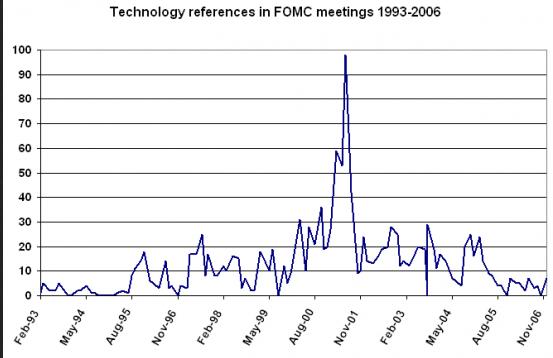
As we've written before, once the tech bubble burst — and Greenspan was supposedly proved so very wrong — the whole idea of technology being a fundamental force in the real economy was abandoned. This is well illustrated by the sudden fall in references to technology in FOMC meetings (as tracked by us):

Apart from a few fringe voices, the technology factor — and its likely effect on the natural unemployment rate as society moves towards a more leisure-focused framework, since all the hard jobs are done by robots and computers — became victim to a deathly silence in the world of serious economic thinking.

Indeed, when we first started considering the idea that technology could be behind the move to zero yields — with the crisis a function of technology shifts than anything else (especially if you follow the Keynesian view that one day a leisure economy becomes inevitable) — there was barely anyone out there to cite on the matter, apart from the Skidelskys and advocates of the Singularity movement.

There has been more commentary since then. George Magnus at UBS, for example, wrote a noteworthy piece in September.

But there has also been commentary to the contrary. Most notably there's the view set out by Robert Gordon (and Peter Thiel) that the crisis was a function of a lack of innovation and technology.

This concept caught the imagination of a lot of people, bringing technology's influence back to the forefront, while also reviving the whole idea of "limits to growth" and us being near that limit point.

Harvard's Ken Rogoff recently debated this point of view with both Thiel and Gordon, but seemed to arrive at a different conclusion. As his op-ed set out last week:

There are certainly those who believe that the wellsprings of science are running dry, and that, when one looks closely, the latest gadgets and ideas driving global commerce are essentially derivative. But the vast majority of my scientist colleagues at top universities seem awfully excited about their projects in nanotechnology, neuroscience, and energy, among other cutting-edge fields. They think they are changing the world at a pace as rapid as we have ever seen. Frankly, when I think of stagnating innovation as an economist, I worry about how overweening monopolies stifle ideas, and how recent changes extending the validity of patents have exacerbated this problem.

We feel this is a hugely important point. For what Rogoff is saying is that if we are experiencing technology stagnation, it's not because humanity has suddenly become less innovative. Rather, it's because incumbent interests now have the biggest incentive ever to impose artificial scarcity, which is stopping the speed of innovation.

Our own personal view is that this is because we've now arrived at a point where technology begins to threaten return on capital, mostly by causing the sort of abundance that depresses prices to the point where many goods have no choice but to become free. This is related to the amount of "free working" hours now being pumped into the economy — the result of crowd sourcing and rising productivity levels — thanks, in part, to the sort of gadgets that allow everyone to work anywhere and anytime, in a work environment that's generally speeding up as everyone tries to keep up with the competition by doing yet more hours voluntarily.

Patent wars, meanwhile… and the rise of companies whose entire raison d'etre is focused on protecting patents… is the ultimate counter force. As a recent Fed paper spelled out, there is real evidence to suggest that idea monopolisation has become a hugely counter-productive force in the economy.

We particularly enjoyed this opinion piece by Steven Levy at Wired Magazine on what he described as the emerging "patent problem".

As he explained:

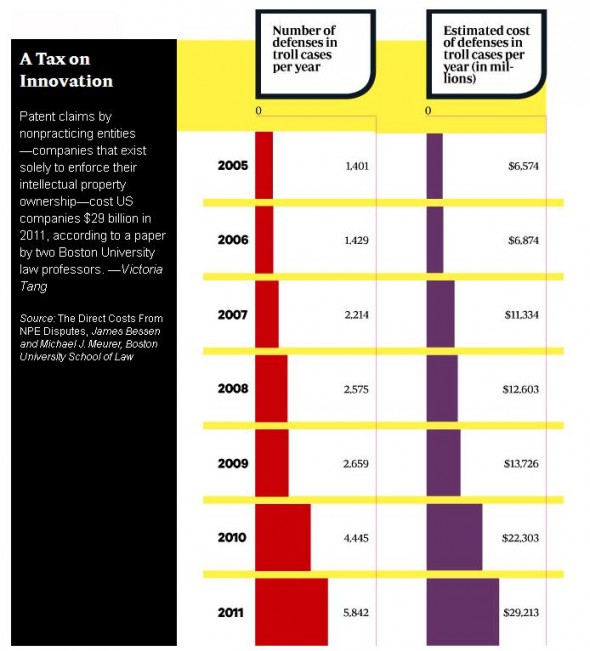
The flaws of the patent system are most vividly exposed by the rise of trolls. The term, inspired by the stunted opportunists of myth, came from an Intel vice president who had been sued for calling a lawyer a "patent extortionist" and needed another expression. It refers to a company that doesn't make products but exists solely on the revenue of its patents. In the parlance of today's patent ecosystem, trolls are known as nonpracticing entities, or NPEs.

The rise of the patent troll effect, meanwhile, is well illustrated by the following Wired graphic:

Which brings us neatly to the latest offering on the technology factor, this time from Paul Krugman — who seems to have spent a large portion of the week thinking about the issue, with no less than two robot-themed postings.

But it's his last one which presents the monopolisation effect best, as he considers what's driving the share of non-farm business sector output downwards so rapidly:

But there's another possible resolution: monopoly power. Barry Lynn and Philip Longman have argued that we're seeing a rapid rise in market concentration and market power. The thing about market power is that it could simultaneously raise the average rents to capital and reduce the return on investment as perceived by corporations, which would now take into account the negative effects of capacity growth on their markups. So a rising-monopoly-power story would be one way to resolve the seeming paradox of rapidly rising profits and low real interest rates.

In our opinion that one paragraph explains today's reality perfectly.

So, robot and technology power is reducing the natural employment rate. But rather than our subsidising those who have lost jobs to technology, so as to spread that manna wealth that's literally dropped onto the surface of the earth at no-one's physical disadvantage, companies are using monopoly power to extort rents on the capital that is creating all that free wealth.

That's why inequality is rising.

As technology proceeds in a patent-obsessed world, the fruits of innovation flow to the owners of the capital and invention, forming a whole new rentier class. The financial assets/debts that back the innovation technology, meanwhile, get disproportionally valuable as their purchasing power gets completely out of whack with the output they radically accelerate.

If you think about it, inequality is always going to be the natural consequence of a technologically-driven deflationary environment. Whereas in inflation, those with financial claims (a.k.a money) are impoverished as their purchasing power is eroded, while those in debt are enriched — in deflation, those with financial claims (the result of increasing rentier flows, if Krugman's point is valid) become enriched as those in debt become increasingly impoverished.

In that sense QE and any move to "debase" financial claims is a move to dilute the wealth effect on legacy claims, which now claim a disproportionate share of available output, at least compared to what they did when they were created.

Low interest rates in many ways are thus only self-correction mechanism bringing the system back to balance — trying to offset the growing power of the innovation-based capital rentier class.

In that context it's understandable that the older the claim, the more preferable it is to hoard it, since the greater its claim over today's output. And in an environment where such claims are self-correcting anyway — via capital destruction brought on by negative rates, as people rush to invest in anything that gives them disproportional access to output and thus crowd each other out — that some of the rentier class see it logical to hoard in non-perishable assets "which cannot be debased" instead is an understandable consequence.

Related links:
Robots! No Robots! – FT Alphaville
Ahhhh! No robots! – FT Alphaville
The Patent Problem – Wired
Whose idea is it anyway – Towards a Leisure Society
Beyond Scarcity – FT Alphaville (series)
Peter Diamandis: Abundance is our future – Ted Talks


Sent from my iPhone

Monday, December 3, 2012

In Entitlement America, The Head Of A Household Of Four Making Minimum Wage Has More Disposable Income Than A Family Making $60,000 A Year | ZeroHedge

In Entitlement America, The Head Of A Household Of Four Making Minimum Wage Has More Disposable Income Than A Family Making $60,000 A Year

Tonight's stunning financial piece de resistance comes from Wyatt Emerich of The Cleveland Current. In what is sure to inspire some serious ire among all those who once believed Ronald Reagan that it was the USSR that was the "Evil Empire", Emmerich analyzes disposable income and economic benefits among several key income classes and comes to the stunning (and verifiable) conclusion that "a one-parent family of three making $14,500 a year (minimum wage) has more disposable income than a family making $60,000 a year." And that excludes benefits from Supplemental Security Income disability checks. America is now a country which punishes those middle-class people who not only try to work hard, but avoid scamming the system. Not surprisingly, it is not only the richest and most audacious thieves that prosper - it is also the penny scammers at the very bottom of the economic ladder that rip off the middle class each and every day, courtesy of the world's most generous entitlement system. Perhaps if Reagan were alive today, he would wish to modify the object of his once legendary remark.

From Emmerich:

You can do as well working one week a month at minimum wage as you can working $60,000-a-year, full-time, high-stress job.

My chart tells the story. It is pretty much self-explanatory.

Stunning? Just do it yourself.

Almost all welfare programs have Web sites where you can call up "benefits calculators." Just plug in your income and family size and, presto, your benefits are automatically calculated.

The chart is quite revealing. A one-parent family of three making $14,500 a year (minimu wage) has more disposable income than a amily making $60,000 a year.

And if that wasn't enough, here is one that will blow your mind:

If the family provider works only one week a month at minimum wage, he or she makes 92 percent as much as a provider grossing $60,000 a year.

Ever wonder why Obama was so focused on health reform? It is so those who have no interest or ability in working, make as much as representatives of America's once exalted, and now merely endangered, middle class.

First of all, working one week a month, saves big-time on child care. But the real big-ticket item is Medicaid, which has minimal deductibles and copays. By working only one week a month at a minimum wage job, a provider is able to get total medical coverage for next to nothing.

Compare this to the family provider making $60,000 a year. A typical Mississippi family coverage would cost around $12,000, adding deductibles and copays adds an additional $4,500 or so to the bill. That's a huge hit.

There is a reason why a full time worker may not be too excited to learn there is little to show for doing the "right thing."

The full-time $60,000-a-year job is going to be much more demanding than woring one week a month at minimu wage. Presumably, the low-income parent will have more energy to attend to the various stresses of managing a household.

It gets even scarier if one assumes a little dishonesty is throwin in the equation.

If the one-week-a-month worker maintains an unreported cash-only job on the side, the deal gets better than a regular $60,000-a-year job.  In this scenario, you maintain a reportable, payroll deductible, low-income job for federal tax purposes. This allows you to easily establish your qualification for all these welfare programs. Then your black-market job gives you additional cash without interfering with your benefits. Some economists estimate there is one trillion in unreported income each year in the United States.

This really got me thinking. Just how much money could I get if I set out to deliberately scam the system? I soon realized that getting a low-paying minimum wage job would set the stage for far more welfare benefits than you could earn in a real job, if you were weilling to cheat. Even if you dodn't cheat, you could do almost as well working one week a month at minimum wage than busting a gut at a $60,000-a-year job. 

Now where it gets plainly out of control is if one throws in Supplemental Security Income.

SSI pays $8,088 per year for each "disabled" family member. A person can be deemed "disabled" if thy are totally lacking in the cultural and educational skills needed to be employable in the workforce.

If you add $24,262 a year for three disability checks, the lowest paid welfare family would now have far more take-home income than the $60,000-a-year family.

Best of all: being on welfare does not judge you if you are stupid enough not to take drugs all day, every day to make some sense out of this Mephistophelian tragicomedy known as living in the USA:

Most private workplaces require drug testing, but there is no drug testing to get welfare checks.

Alas, on America's way to to communist welfare, it has long since surpassed such bastions of capitalism as China:

The welfare system in communist China is far stringier. Those people have to work to eat.

We have been writing for over a year, how the very top of America's social order steals from the middle class each and every day. Now we finally know that the very bottom of the entitlement food chain also makes out like a bandit compared to that idiot American who actually works and pays their taxes. One can only also hope that in addition to seeing their disposable income be eaten away by a kleptocratic entitlement state, that the disappearing middle class is also selling off its weaponry. Because if it isn't, and if it finally decides it has had enough, the outcome will not be surprising at all: it will be the same old that has occurred in virtually every revolution in the history of the world to date.

h/t Nolsgrad


Sent from my iPhone

Is This Why Americans Have Lost The Drive To "Earn" More | ZeroHedge

Is This Why Americans Have Lost The Drive To "Earn" More

In the recent past we noted the somewhat startling reality that "the single mom is better off earning gross income of $29,000 with $57,327 in net income & benefits than to earn gross income of $69,000 with net income and benefits of $57,045." While mathematics is our tool - as opposed to the mathemagics of some of the more politically biased media who did not like our message - the painful reality in America is that: for increasingly more Americans it is now more lucrative - in the form of actual disposable income - to sit, do nothing, and collect various welfare entitlements, than to work. This is such an important topic that we felt it necessary to warrant a second look. The graphic below quite clearly, and very painfully, confirms that there is an earnings vacuum of around $40k in which US workers are perfectly ambivalent toward inputting more effort since it does not result in any additional incremental disposable income. With the ongoing 'fiscal cliff' battles over taxes and entitlements, this is a problematic finding, since - as a result - it is the US government that will have to keep funding indirectly this lost productivity and worker output (via wealth redistribution).


As we noted before (details below):

We realize that this is a painful topic in a country in which the issue of welfare benefits, and cutting (or not) the spending side of the fiscal cliff, have become the two most sensitive social topics. Alas, none of that changes the matrix of incentives for most Americans who find themselves in a comparable situation: either being on the left side of minimum US wage, and relying on benefits, or move to the right side at far greater personal investment of work, and energy, and... have the same disposable income at the end of the day.

Naturally, the topic of wealth redistribution is paramount one now that America is entering the terminal phase of its out of control spending, and whose response to hike taxes in a globalized, easily fungible world, will merely force more of the uber-wealthy to find offshore tax jurisdictions, avoid US taxation altogether, and thus result in even lower budget revenues for the US. It explains why the cluelessly incompetent but supposedly impartial Congressional Budget Office just released a key paper titled "Share of Returns Filed by Low- and Moderate-Income Workers, by Marginal Tax Rate, Under 2012 Law" which carries a chart of disposable income by net income comparable to the one above.

But perhaps the scariest chart in the entire presentation is the following summarizing the unsustainable welfare burden on current taxpayers:

  • For every 1.65 employed persons in the private sector, 1 person receives welfare assistance
  • For every 1.25 employed persons in the private sector, 1 person receives welfare assistance or works for the government.

The punchline: 110 million privately employed workers; 88 million welfare recipients and government workers and rising rapidly.

And since nothing has changed in the past two years, and in fact the situation has gotten progressively (pardon the pun) worse, here is our conclusion on this topic from two years ago:

We have been writing for over a year, how the very top of America's social order steals from the middle class each and every day. Now we finally know that the very bottom of the entitlement food chain also makes out like a bandit compared to that idiot American who actually works and pays their taxes. One can only also hope that in addition to seeing their disposable income be eaten away by a kleptocratic entitlement state, that the disappearing middle class is also selling off its weaponry. Because if it isn't, and if it finally decides it has had enough, the outcome will not be surprising at all: it will be the same old that has occurred in virtually every revolution in the history of the world to date.

But for now, just stick head in sand, and pretend all is good. Self-deception is now the only thing left for the entire insolvent entitlement-addicted world.

* * *

Full must read presentation: "Welfare's Failure and the Solution"


Some other thoughts on this topic: DOES IT PAY, AT THE MARGIN, TO WORK AND SAVE?

Your rating: None Average: 4.4 (35 votes)


Sent from my iPhone

Wednesday, October 3, 2012

Works and Days » The Quiet Californians

The Quiet Californians

The Obama Paradox

No state has suffered the last four years as much as has California — given that its progressive governor and legislative majorities serve as force multipliers for the Obama national agenda. We live in a 2X Obama state. And it is desirous for twelve or sixteen, not just four, more years in Washington.

The bluest state is polling at a 20 to 24 point lead for Barack Obama. Who cares that it is struggling with nearly 11% unemployment and facing a $16 billion budget shortfall? What does it matter that its public schools rated variously from 45th to 49th in the nation and that it is home to one-third of the nation's welfare recipients, forty percent of the nation's illegal aliens, and the largest prison population in the country? If Ohio supposedly has a million Obama-phones, I shudder to wonder how many are in California.

Bleak? But such stats do not necessarily translate into the bad life for those Californians who vote — a least in comparison, I suppose, to Minnesota's winters, Mississippi's rate of welfare payouts, Baltimore's streets, or Mexico's police. We are living on the fumes of natural wealth and a century of prior investment by some pretty hard-working and far-sighted long dead Californians; and it takes a long time to screw all that up.

Indeed, the state's voting population accepts the status quo: the growing underclass expects entitlements always to grow even greater; state employees are more than happy with in-the-future-unsustainable benefits and packages; and the coastal elite have enough money that they do not care whether they have to pay a bit more to subsidize others and create tranquility in their anointed souls. Meanwhile, California is clear and 78 degrees without humidity — in late September.

Fiddling While…

In other words, we are a happy-go-lucky, sunny Greece around 2004 before the fall — a Mykonos or Rhodes with a German ATM machine. Those sourpusses in the private sector who are not happy and not rich either have left or contemplate leaving — or hide and hope the scanning, red-eye gaze of Sauron in the dark tower at Sacramento passes them over, at least on this latest sweep. As one of my local critics told me, "Get over it!" and "You're just jealous" — and, my favorite, "Why not leave, then?"

Two miles away someone found a corpse a while back in a small Selma park that was once lovely; in high school I once helped to plant trees there. The murdered? No biography, no name, no details of the deceased. I suppose someone brought him to the morgue, and some next of kin went to the coroner's office. End of story. Forty years ago it would have been front-page news; today it is not even a footnote. The anonymous and unknown killer? I suppose I pass him often on the way into town.  The point is that corpses now just show up out here, cars are found abandoned in vineyards, and dogs wander around without owners, all as the new normal. The quietist tiptoes around it — given that those who caused the conditions who spawned the chaos are usually far away in the Berkeley Hills or Newport Beach.

More Money

This November the California voting public is poised to raise state income taxes on the top earners to over 12%, ensuring that the state's rates top both Hawaii's and Oregon's. With sky-high sales and gas taxes, Californians are already the highest-taxed in the nation. The state's schools and infrastructure are among the very worst. In the old days, one might write, "Despite high taxes, California public schools are poor." But we are getting to the point in California where quietists say, "Because of high taxes, schools are.…" Or: "Due to high taxes, schools are…." More money, not reform, is always the answer and therefore there is never reform.

When the UC chancellor writes alumni that without a new tax hike "higher education itself is imperiled," don't assume that he means the UC diversity czar and his horde of $100,000 per year assistants are slated for lay-offs. He means instead that students will pay more fees and the French or classics department may be shut down. (And no, reader, there is no irony here: the targeted French professor never makes the connection that his job is in the cross-hairs because there is a new bureaucracy to figure out how Berkeley is racist by having Asians "overrepresented" four-fold, whites slightly underrepresented, and Latinos in much smaller numbers on campus than their percentages of the state population.)  

Failure Is Very Much an Option

We know what would save the state's public schools — a return to grammar and syntax, reading, history, math, science, and the elimination of the entire therapeutic, multicultural, and politically correct curriculum. But we, the quiet ones, also know that to reset schools would evoke such outcry that it is not worth the effort — take the Wisconsin mess and treble it here. The rich who designed and hence ruined the K-12 public schools avoid them; the middle class seeks to staff and run them; the poor both suffer in them and do their own smaller part to make things worse. (Cannot we also blame the gang-banger who sneers at the teacher while he uses his cell phone in class, or the 15-year-old girl who needs prenatal counseling, or the graffiti artist who destroys the bathroom?)

Why the disconnect between abject political failure and overwhelming public support for what is destroying the state? Silicon Valley is booming. Apple may become the wealthiest company in history. Google, Sun Microsystems, Intel, Yahoo, eBay, and Hewlett-Packard rack up billions in worldwide revenue. Chevron still has lots of oil and gas wells, and is redeveloping them at record prices. The California Rule: Liberals are quite conservative in the way they make money. Apple cuts costs. Google lays off employees. Intel demands results. In an odd Obama-way, California businesses have an advantage: because they vote so liberally, they can do almost anything they please.

As long as someone wants an iPhone in Lima, and another in Mumbai sprinkles almonds on his rice, or a cash-flush Chinese provincial governor sends his only son to Caltech, things in California can go on for some time.

Quietism

How do sane people, without great wealth that might provide exemption from all this, cope? They tune out. They psychologically drop out, in the manner of the ancient quietists of Athens in the 4th-century B.C. (the apragmones in search of hesuchia) who learned that one cannot fight the mob, but only seek to escape it. I bump into and talk with these latter-day quietists quite often. They are generally happy folk but have developed a certain psychological protocol by which to survive. The quietist trusts more the ancient wisdom in hallowed texts that warns democracy implodes when the masses finally assume absolute control and vote themselves entitlements that even the shrinking rich can no longer sustain.  So they don't get in the way between the mob and their entitlements.

Look on the Bright Side

If the state idles farm land, puts drilling off limits, and drives out business, the quietist accepts that those who do such things do them because they never affect the authors directly, and when in the future they do, they will cease and desist — and it will be mostly too late. He assumes that the whiners at the $4 a gallon gas pump never make the equation that there may be 30 billion barrels in untapped oil 150 miles away, right off the California shore. (Instead, "they" rigged the prices.) The quietist assumes that few connect the horrific highways to an incompetent state whose highest gasoline taxes in the nation have translated into some of the country's worse roads, or to the drivers who customarily lose brush, limbs, and mattresses from their trucks, shutting down lanes for hours.

No matter  – the quietist adjusts and drives at weird hours, as if he were some owl or nocturnal beast; it is not that hard to live a life pretty much opposite of what the majority does. There are plenty of quietists who can advise you. They are experts on how to navigate in a beautiful but otherwise insane state. Ask a tree-cutter, small garage owner, custom tractor driver, or self-employed tile setter — they all have advice on how to survive. Usually, however, they end with something like, "Of course my kids should get a state job." In 1960, rare state employees were noble folk who were willing to make less for job security and a sense of public service; today they are lotto winners who hit the jackpot.

Empty States within a State

The Coast Ranges and the vast Sierra — outside a Yosemite or Tahoe — are as empty as Alaska. For all the Sierra Club protestations, few Marin County lawyers visit the upper San Joaquin River. They just wish no one else would as well. Although the mountain beauty is within an hour of greater Fresno's million, apparently the Hondas and Camrys of the deprived poor can't make up the grade, so the Sierra remains a haven for the quietist. In fact, one can drive to Cayucos on the coast, or Florence Lake in the High Sierra, or anywhere above Sacramento, and see almost no one. And to prevent insanity, the quietist keeps reminding himself, "Is such beauty, such weather, such solitude not worth a 12% premium on your income, or an hour a night to teach your child what she did not learn in school, or a little vigilance to mostly avoid what Los Angeles has become?" I am currently computing the cost of losing copper wire in all my pumps versus seeing the sun all of October. In California, one comes at the expense of the other.

The quiet Californian assumes that each year a new regulation, a new tax, a new something will seek him out. I read the "State Franchise Tax Board" print as I do the hate letters or emails I receive — incoherent, threatening. This year I got a letter from the state explaining that based on my income they "estimated" that I must have used the Internet to buy x-amount of things and therefore did not pay state sales taxes. Thus, they suggested that I should pay them around, say, $600.

Another such letter came from the Ministry of Revenue yesterday. The state says I have a house in the mountains and therefore may some day require auxiliary state fire protection and therefore should send them, say, $150 — or else!

Note that I pay local taxes to fund county and municipal police and fire. I give generously to the local volunteer fire department. (Would the state send someone in East L.A. some such letter, saying that because they live in an area that often requires the intervention of state law enforcement and SWAT teams, they should send in $150 protection money?) There is never any contract, warning, law — only a need for cash that justifies such confiscation.

So quietist Californians expect about every six months a new fee, dreamed up by a government employee who is paranoid that the state retirement system is broke, and with it his pension. The state employee is now entrepreneurial: without  a certain number of traffic tickets written, without  a certain number of new fees dreamed up, salaries and benefits dry up. I touch my rural mailbox as I do metal after skidding on a new carpet — a sort of static feeling of anxiety about what new state directive is inside.

I pick up the local paper: it has become a litany of rapes, murders, gang shootings, and molestations, peppered with drunk-driving fatalities and the uninsured and unlicensed who maim and kill routinely. The lurid tales of crime seem almost as if they come from a Sao Paulo suburb or the outskirts of Johannesburg. Yet the more violence, the more worry about insensitivity. So there is a general rule: the name of the driver, the killer, the robber, or the rapist arrested is rarely initially disclosed, much less his biography or photo — as if these are just random stats that can offer no higher wisdom. No worry — there is an answer to our world of Mad Max. Governor Brown will borrow $200 million for high-speed rail.

I note that an exception in California is the marquee universities.

A Stanford, for example, is home to elites and therefore it must be crime-free, so they often send out life-saving "alerts" that pop up in your email when a male has groped, attacked, or threatened a co-ed on campus. Oddly, the descriptions are graphically explicit: even though we are dealing with suspects — not the arrested. And so the appearance, size, and ethnic profile of the supposed attacker are provided in great, politically incorrect detail. One thing about liberalism: it takes care of its own.

Quietists of the State, Unite!

The quietist assumes that his vote for president does not matter and won't in the state for the next century. He assumes that whom he votes against for governor will win, and that his legislator will either be opposed to everything he believes or, if he is not, will be equally as irrelevant — and yet in homage to the state, he keeps voting religiously and laughing about it with other quietists.

Quietists have become bystanders, now marginalized to be sure, but also convinced that the relevant ones are, in history's cruel calculus, quite unhinged. I have a confession: I like the quietists of California. I see them every day. They keep chugging away — and their spirits keep me going.


Sent from my iPhone

Tuesday, September 18, 2012

Althouse: The secret video of Romney talking to donors.

Althouse

Presented at Mother Jones as if it's quite disturbing, but I don't see anything bad in there at all.
There are 47 percent of the people who will vote for the president no matter what. All right, there are 47 percent who are with him, who are dependent upon government, who believe that they are victims, who believe the government has a responsibility to care for them, who believe that they are entitled to health care, to food, to housing, to you-name-it. That that's an entitlement. And the government should give it to them. And they will vote for this president no matter what…These are people who pay no income tax.
And then he says he can't "worry about those people" as he tries to win votes, because they will never be convinced. He's not saying he doesn't care about them as citizens and human beings, just that he won't devote any attention to trying to cull some of their votes.

Compare the statements Obama made to donors in 2008, which were leaked out — the famous "bitter clingers" remarks.
You go into some of these small towns in Pennsylvania, and like a lot of small towns in the Midwest, the jobs have been gone now for 25 years and nothing's replaced them," Obama said. "And they fell through the Clinton Administration, and the Bush Administration, and each successive administration has said that somehow these communities are gonna regenerate and they have not. And it's not surprising then they get bitter, they cling to guns or religion or antipathy to people who aren't like them or anti-immigrant sentiment or anti-trade sentiment as a way to explain their frustrations."

Obama made a problematic judgment call in trying to explain working class culture to a much wealthier audience. He described blue collar Pennsylvanians with a series of what in the eyes of Californians might be considered pure negatives: guns, clinging to religion, antipathy, xenophobia.


Sent from my iPhone

Friday, September 7, 2012

Obama at the DNC: That’s it? - Right Turn - The Washington Post

Obama at the DNC: That's it?

Posted at 11:33 PM ET, 09/06/2012

It would have been better had he not spoken. Seriously. Like an aging rock star, President Obama, in a downsized venue, with downsized proposal and spewing downsized rhetoric only reminded us how far he has fallen from the heady days of 2008. The man, the agenda and the aura are faint imitations of their 2008 incarnations. And most importantly, he put forth an agenda that was entirely, and obviously, lacking, one that didn't begin to match the demands of our time.

Even for the liberal media, it will be hard to characterize a speech this prosaic as uplifting or fresh. The crowd — you know, the people who favor abortion on demand up to birth, all paid for by the government -- were thrilled at the onset, although quiet during long stretches of the speech. On TV the speech came across in large part as flat. It was frankly not as good a speech as his wife's.

But what did he say? Where is the argument for his re-election?

As a preliminary matter he played the victim unconvincingly. ("I know that campaigns can seem small, and even silly. Trivial things become big distractions. Serious issues become sound bites. And the truth gets buried under an avalanche of money and advertising. If you're sick of hearing me approve this message, believe me – so am I.") Since it is his own campaign that is irredeemably negative and petty he really has no claim to the high ground.

And since he previously extended the Bush tax cuts it was hard to reconcile his disdain for extending them now in an even weaker economy. (" I don't believe that another round of tax breaks for millionaires'; but how about for small businessmen?)

Let's start with his $4 billion debt reduction package. Remember, Obama has added more than $5 trillion to the debt since entering office. But more to the point, the plan has already been discredited. The Post's Glenn Kessler explained the claim to cut the debt by $4 trillion "is simply not accurate":

By the administration's math, you have nearly $3.8 trillion in spending cuts, compared to $1.5 trillion in tax increases (letting the Bush tax cuts expire for high-income Americans). Presto, $1 of tax increases for every $2.50 of spending cuts.
But virtually no serious budget analyst agreed with this accounting. The $4 trillion figure, for instance, includes counting some $1 trillion in cuts reached a year ago in budget negotiations with Congress. So no matter who is the president, the savings are already in the bank.
Moreover, the administration is also counting $848 billion in phantom savings from winding down the wars in Iraq and Afghanistan, even though the administration had long made clear those wars would end.
In other words, by projecting war spending far in the future, the administration is able to claim credit for saving money it never intended to spend. (Imagine taking credit for saving money on buying a new car every year, even though you intended to keep your car for 10 years.)
Rather than good arithmetic, independent budget analysts called the maneuver "a major budget gimmick."
The administration also counts $800 billion in savings in debt payments (from lower deficits) as a "spending cut," which is a dubious claim. We didn't realize that debt payments were now considered a government program.
There are a number of other games being played, so fake money is being used to pay for real spending projects. In effect, most of Obama's claimed deficit reduction comes from his proposed tax increases

There was a reason of course that lefty bloggers tried (unsuccessfully) to "fact check" this analysis; they saw quite clearly how devastating it would be for the man selling himself as brave and responsible to come out with a plan so puny and phony. (A helpful analysis debunking the president's plan was also put out by the Senate Budget Committee's ranking member. "Overall, the President proposes to spend $1.4 trillion more than we would spend if no policy changes were made, meaning the President's $1.6 trillion tax hike is used to fund new spending, not to lower deficits.")

But that die was cast long ago. This president is not there to solve our fiscal problems. He is there to grown government.

No matter how desperately the Obama team spins, there is no getting away from this simple fact: He has no credible plan to reduce the debt or intention of attacking the drivers of debt, namely entitlement spending. For those Democrats and independents who though he would eventually get serious about our most serious problem, the answer tonight was: "You've been had".

What followed was one spending program after another, as if no debt crisis loomed and as if the key to jump-starting the economy were to spend more money. (Recall we have spent trillions and trillions already.) It was, to put it mildly, shockingly weak and rather dull. Before our eyes, Obama has become the anti-reformer, the defender of the status quo and the throw back to mid-20th century liberalism.

As the Romney team and the RNC were only too eager to point out in a flurry of press releases, Obama already has promised virtually every item on his 2012 wish list — in his 2008 acceptance speech. He wants to reduce unemployment and help the middle class . We are expected, he says, to be "patient." But why give him another chance to get it right by simply doing more of the same?

When you've promised before to create manufacturing jobs, double exports, cut tuition in half, lessen our dependence on foreign oil and stick two million (!) people in community college and failed to do it, why should the American people believe this set of pie in the sky promises.

The speech was terribly government-centric, even for a Democrat. Obama urged the audience not to think there is a government program for all ills, but then came up with one government program after another. Does he think that adding a bunch of government programs will grown the economy? There was no hint that the economy was still anemic, millions remained unemployed and in poverty and his already huge increase in government has not brought a new age of prosperity.

However, one thing he didn't tout, indeed he did not mention his signature achievement Obamacare. His finest moment can't even be mentioned in public. Although he mischaracterized the Romney-Ryan Medicare plan as "Vouchercare", he offered little of his own regarding reform of either Medicare or Social Security. This was political timidity of the worst kind.

But he was perhaps most disingenuous on national security. We sit on the precipice of defense cuts his own defense secretary says would be "devastating." He then tells the crowd that the way to improve national security is to take money from defense and spend it --- excuse me — invest it on "nation-building here at home." And he mentioned Israel in passing, but, after the events of the past week, did not identify its capital. He didn't even both to tell Iran all options remain on the table. ("The Iranian government must face a world that stays united against its nuclear ambitions.") It was fair warning that this president intends in a second term to show all the "flexibility" he can muster — to soothe our foes.

Instead he taunted Romney, accusing him of wanting to go back to the "blustering and blundering that cost America so dearly." It was nervy for the president who has alienated allies, told the Russian president he'd be more flexible and savaged defense spending to accuse his opponent of being naive on national security.

The Romney camp will breathe a sigh of relief. There is nothing in the speech we have not heard, nor is there any sense that Obama has grown in the job, is ready to tell his own party (let alone the public, as he claims he has done) hard truths or do what may be unpopular but is nevertheless essential. He leaves the field wide open for Mitt Romney to be the adult in the race, the responsible leader. If Romney can fully embrace that role, the presidency will be his.


Sent from my iPad

Wednesday, September 5, 2012

Better Off Under Obama? Let's Count The Ways We're Not - Investors.com

Better Off? Let's Count the Ways We're Not

Economic Conditions: All weekend, Democratic party leaders kept fumbling their answer to a simple question: Are we better off than we were four years ago? There's a good reason for that: We're not.

It wasn't until Monday that the campaign was able to figure out how to answer the question, with Obama's deputy campaign manager, Stephanie Cutter, saying, "Absolutely."

Obama's argument is simple: The economy was headed for a second Great Depression when he took office — hemorrhaging GDP and jobs. His stimulus, the auto bailouts and so on, prevented that, and the economy has since been slowly digging out of the massive ditch into which President Bush drove it. Thus, Obama says, he deserves an "incomplete" grade.

It's quite a stretch that Obama stopped another depression. The recession ended just five months into his first term, before most of his policies had a chance to take effect. It's an even bigger stretch to say that people's lives have been improving during the 3-year-old Obama "recovery," which started in June 2009.

By most measures the country isn't making slow progress; it's falling further behind. Some examples:

• Median incomes: These have fallen 7.3% since Obama took office, which translates into an average of $4,000. Since the so-called recovery started, median incomes continued to fall, dropping $2,544, or 4.8%.

• Long-term unemployed: More than three years into Obama's recovery, 811,000 more still fall into this category than when the recession ended.

• Poverty: The poverty rate climbed to 15.1% in 2010, up from 14.3% in 2009, and economists think it may have hit 15.7% last year, highest since the 1960s.

• Food stamps: There are 11.8 million more people on food stamps since Obama's recovery started.

• Disability: More than 1 million workers have been added to Social Security's disability program in the last three years.

• Gas prices: A gallon of gas cost $1.89 when Obama was sworn in. By June 2009, the price was $2.70. Today, it's $3.84.

• Misery Index: When Obama took office, the combination of unemployment and inflation stood at 7.83. Today it's 9.71.

• Union membership: Even unions are worse off under Obama, with membership dropping half a million between 2009 and 2011.

• Debt: Everyone is far worse off if you just look at the national debt. It has climbed more than $5 trillion under Obama, crossing $16 trillion for the first time on Tuesday and driving the U.S. credit rating down.

Ironically, the only people better off under Obama are corporate chieftains, who've seen corporate profits climb more than 50% under Obama's "recovery," and investors, who've benefited from a near-doubling in the Dow industrials from its March 2009 lows.

Given this record, we can only hope Obama doesn't have the chance to get a "complete" on his plans.


Sent from my iPhone